Powder Coating / Surface Finishing
Powder Coating Process Step by Step: What Happens to Your Part?
Powder coating is a three-stage process: surface preparation (cleaning and media blasting), electrostatic powder application, and oven curing at 375 to 400 degrees Fahrenheit. The powder melts and flows into a continuous film, producing a finish that’s harder, thicker, and more impact-resistant than liquid paint and doesn’t require solvents.
What Is Powder Coating?
Powder coating is a dry finishing process where electrostatically charged powder particles are sprayed onto a grounded metal part, then cured in an oven. The heat melts the powder into a smooth, durable film that bonds to the metal surface. No solvents are involved, and the result is a finish thicker and tougher than most liquid paint systems.
Unlike liquid paint, which relies on a solvent carrier that evaporates during drying, powder coating uses dry powder particles held in suspension by compressed air and given an electrostatic charge by the spray gun. That charge is what pulls the powder to the grounded metal surface and holds it in place until the part reaches the curing oven.
The process is highly repeatable. Every part that goes through the same prep, application, and cure cycle comes out with a consistent film thickness and adhesion strength. That repeatability is one reason high-volume fabricators and OEM manufacturers specify powder coating for structural steel parts, agricultural equipment, material handling components, and consumer product frames.
Paragon’s powder coating service runs a high-volume in-house line. Parts that come through our fab shop for laser cutting, forming, or welding can move directly to coating without leaving the facility, which cuts handling time and keeps your delivery date solid.
Step 1: Surface Preparation
Surface preparation is the most critical step in the powder coating process. The metal must be completely clean: free of mill scale, rust, oil, weld spatter, and contamination. Most shops use a combination of chemical wash to remove oils and media blasting to profile the surface. Without proper prep, powder adhesion fails and the coating peels.
The prep sequence typically starts with a wash or solvent wipe to remove cutting oils, grease, and shop dirt that accumulate during fabrication. Steel that’s been laser cut or formed will have some residual oil from the process or from handling. That oil must come off before blasting, or the blast media drives it into the surface profile rather than removing it.
After the chemical wash, most shops move to media blasting, which can use steel grit, aluminum oxide, or glass bead depending on the desired surface profile and the material being coated. Blasting accomplishes two things: it removes surface oxides (mill scale and rust) and it creates a microscopic anchor profile in the metal. That profile gives the powder something to grip mechanically in addition to the chemical bond formed during curing.
The surface profile specification is usually expressed in mils or microinches and matches the powder manufacturer’s recommendation for the product being applied. A surface that’s too smooth won’t hold the powder well; a surface that’s too rough creates pinholes and coverage issues. Getting the profile right is part of the prep process that separates a durable finish from one that fails early in service.
Weld spatter is another prep issue. Spatter beads are poorly bonded metal droplets that sit on the surface. If not removed before coating, they become bumps under the powder film and can pull away from the base metal, lifting the coating around them. Grinding or needle-scaling weld spatter before prep keeps the final surface clean.
Step 2: Powder Application
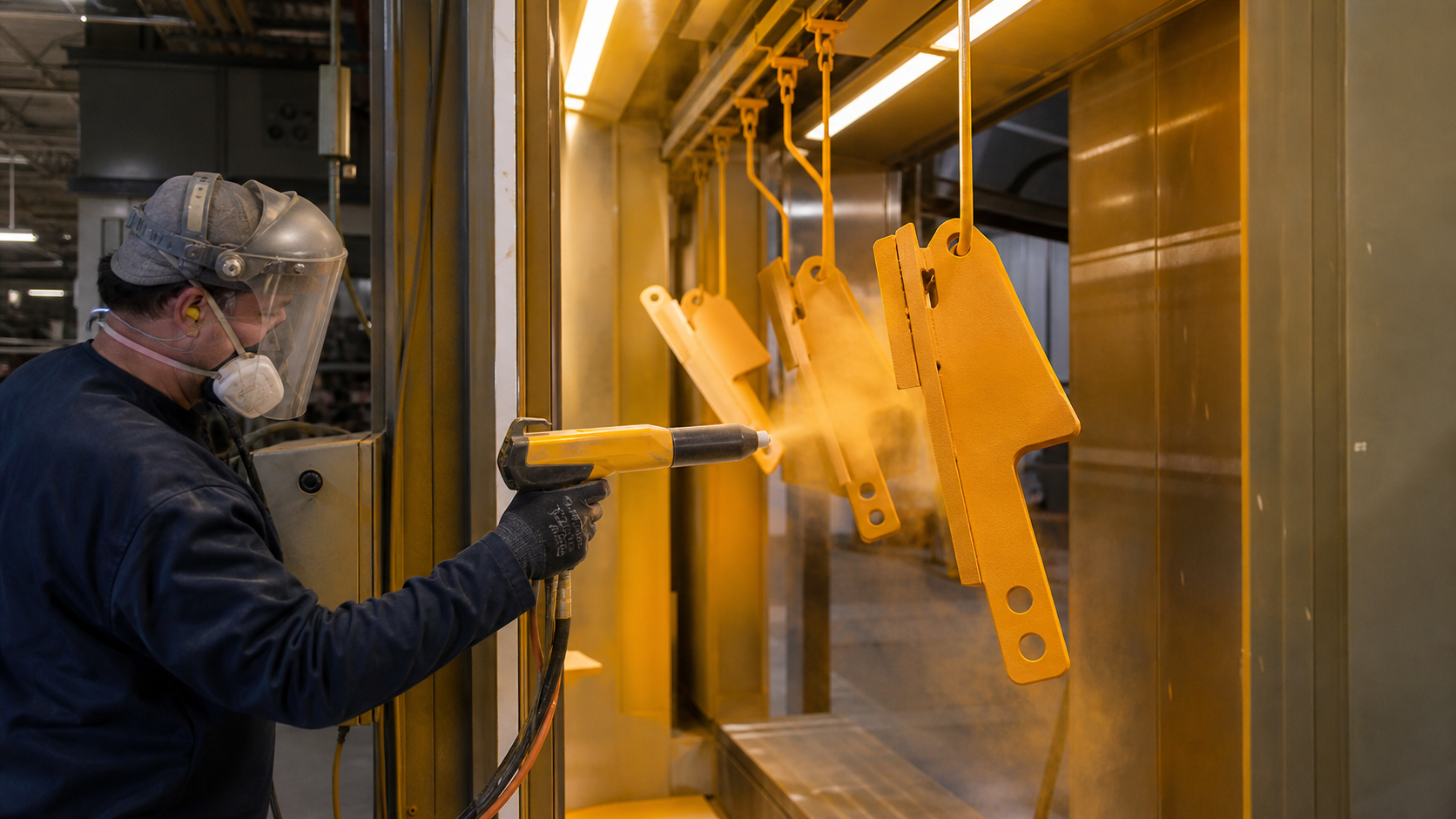
Powder is applied with an electrostatic spray gun that charges the powder particles as they exit the nozzle. The charged particles are attracted to the grounded metal part and wrap around corners and edges by following the electric field. The powder sticks to the metal surface as a loose coating until the part enters the curing oven.
The spray gun creates a cloud of charged powder particles. The metal part is grounded through the conveyor hook or rack, so the electric potential between the charged powder and the grounded part draws the particles in and holds them on the surface. This electrostatic attraction is what allows powder to coat vertical surfaces, edges, and recesses without running or sagging the way liquid paint can.
Film thickness during application is controlled by adjusting spray distance, gun voltage, and line speed. Standard powder coatings run between 2 and 4 mils dry film thickness (DFT), though some heavy-duty or textured coatings go thicker. The application operator monitors film thickness with a probe gauge during the run to catch any areas that are coming in thin or heavy.
Faraday cage areas are a known challenge in powder coating. Deep inside channels, box sections, or recessed cavities, the electric field is weak and the powder doesn’t wrap in effectively. Skilled applicators use specialized nozzles or extended probes to reach those areas. Design features that create Faraday cage situations (like deep slots or blind pockets) are worth flagging before the coating run so the operator can plan the approach.
Masking is used when certain surfaces need to remain uncoated, such as thread forms, bearing seats, or mating surfaces with tight fit tolerances. Plugs, caps, and high-temperature tape are standard masking materials. Parts that require masking should be identified on the print or RFQ so the shop can build masking time into the quote.
Step 3: Curing in the Oven
Curing happens in a convection oven at 375 to 400 degrees Fahrenheit, typically for 15 to 20 minutes at temperature. The heat melts the powder particles into a continuous liquid film that flows, levels, and then cross-links into a hard, chemically bonded coating. The exact cure window depends on the powder chemistry and the part’s mass.
The cure schedule is expressed as time at temperature for the part itself, not just the oven air temperature. A heavy steel weldment takes longer to reach cure temperature than a thin-gauge sheet metal bracket, even in the same oven at the same setpoint. Most powder manufacturers publish cure windows that show the relationship between part temperature and time. Heavier parts need more dwell time in the oven to reach and hold the required cure temperature throughout the cross-section.
Undercure is a real failure mode. A part that never fully reaches cure temperature will have a powder film that’s visually complete but chemically incomplete. The cross-link density is low, and the coating will be softer, less chemically resistant, and more prone to chipping and peeling under impact. You can’t tell an undercured part from a properly cured one by looking at it, which is why oven management and thermocouple monitoring matter.
Overcure causes its own problems, particularly on lighter gauge material. Excessive time at temperature can cause color shifts (especially in whites and yellows), gloss reduction, and in extreme cases, thermal distortion of thin parts. The cure window is a range, not a point, and staying within it produces consistent results.
After curing, parts exit the oven and cool before unracking. The coating reaches its full mechanical properties after cooling to ambient temperature. Parts should not be stacked or wrapped immediately after exit from the oven, as the coating is still soft during the early cooling phase and surface-to-surface contact can leave marks.
What Powder Coating Looks Like in Practice
A properly cured powder coat finish is smooth, hard, and consistent in color across the part. Film thickness typically runs 2 to 4 mils, which is thicker than a standard liquid paint coat. The finish resists chipping, scratching, UV fading, and chemical exposure better than most liquid paint systems used in industrial applications.
Texture options range from smooth gloss to fine texture to heavy wrinkle finishes, depending on the powder formulation. Gloss powders show surface imperfections more readily and require better surface prep. Texture finishes hide prep variations better and are often specified for industrial and agricultural equipment where cosmetics matter less than durability.
Color matching is done through the powder supplier’s standard color library or through custom color matches for OEM programs. Standard colors like safety yellow, OSHA red, and RAL colors are available from stock. Custom matches add lead time and usually require a minimum quantity for the color batch. Metallic and special effect powders are available but carry their own application challenges around coverage uniformity.
For a more detailed look at how powder coating compares to liquid paint in terms of durability and performance, see our powder coating vs. paint comparison page.
What Parts Work Well for Powder Coating?
Powder coating works on any part that can be grounded, heated to cure temperature, and hung on a conveyor hook or rack. Steel structural parts, sheet metal assemblies, brackets, frames, housings, and guards are the highest-volume applications. Parts with deep blind pockets, highly threaded features, or temperature-sensitive inserts require more planning but can often still be coated.
Steel is the most common substrate. Carbon steel, mild steel, and alloy steels all coat well when properly prepared. Galvanized steel can be powder coated but requires a different prep protocol, as the zinc surface behaves differently during blasting and chemical wash. Stainless steel is rarely powder coated because its natural corrosion resistance makes coating unnecessary in most applications, though it’s possible for color or aesthetic purposes.
Aluminum powder coating is well established in the architectural and consumer products markets but is handled differently from steel. Aluminum oxide forms naturally on the surface and requires specific chemical pretreatment (typically a chromate or chromate-free conversion coating) to promote adhesion. Our shop focuses on steel fabrication, so aluminum coating questions are worth discussing with our team directly.
Parts with threaded features need masking or plug protection before coating to prevent powder buildup that would interfere with thread engagement. Tapped holes, bolted flanges, and precision bearing bores are typical masking locations. The fabricator or coater needs to know these are present before the job starts.
You can see the range of parts we handle across our full services overview, and for a full picture of our facility and line capacity, visit our facilities page.
Ready to Finish Your Parts?
Paragon runs an in-house powder coating line alongside laser cutting, forming, welding, and more. If your parts need fabrication and coating under one roof in Northern Kentucky, let’s talk.
Frequently Asked Questions
How thick is a powder coating finish?
Standard powder coating runs 2 to 4 mils (0.002 to 0.004 inches) dry film thickness. Heavier texture powders or specialty coatings can go thicker. The exact target thickness depends on the powder specification and the application requirements. Film thickness is checked during the run with a magnetic probe gauge on steel substrates.
Can you powder coat a part that’s already been welded?
Yes. Welded assemblies are one of the most common powder coating applications. Weld spatter needs to be removed during surface prep, and any pinholes or porosity in welds can trap gas during curing and cause outgassing defects in the coating. Tight, clean welds with proper prep coat well. Our team reviews welded assemblies as part of the prep process.
How many colors are available in powder coating?
Standard color libraries from major powder suppliers cover hundreds of options, including RAL colors, OSHA safety colors, gloss levels, and textures. Custom color matches are possible but add lead time and typically require a minimum batch quantity. Metallic and special-effect powders are also available. Contact our team with your color spec and we’ll confirm availability and lead time.
Does powder coating add significant dimension to a part?
At 2 to 4 mils per side, powder coating adds 0.004 to 0.008 inches to a surface overall (both sides combined). For most structural and general-purpose parts this is not a concern. For precision fits, press fits, or thread engagement areas, the coating should be masked off to keep those features at their nominal dimension.
What’s the lead time for powder coating at Paragon?
Lead time depends on the job size, current line loading, and whether the parts are coming through our fabrication process or arriving coated-only. Parts that move through our fab shop go to the coating line on the same production schedule. Coating-only jobs are quoted with lead time at the time of inquiry. Call us at 1-800-467-0121 or submit a quote request to get a current schedule.
or call 1-800-467-0121