Metal Finishing / Surface Coating
Powder Coating vs Paint: Which Finish Is Better?
Powder coating is the stronger, longer-lasting finish for most metal parts. It bonds through heat, resists chips and UV better than liquid paint, and holds its color up to twice as long. Paint is still the right call for certain substrates, complex shapes, and specialty colors that powder can’t accommodate.
How Does Each Process Work?
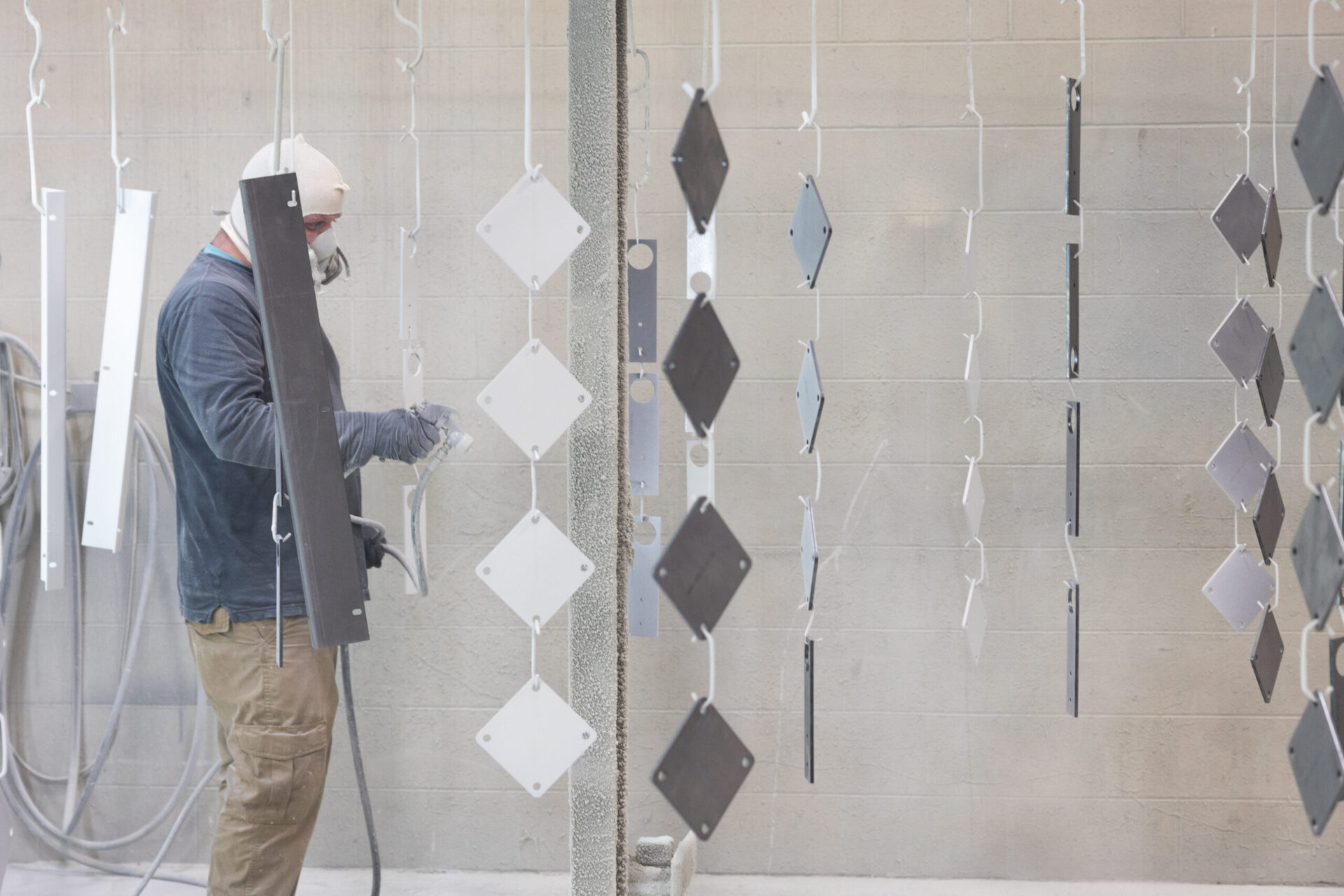
Powder coating applies a dry, electrostatically charged powder to a grounded metal part. The part then bakes in an oven, fusing the powder into a smooth, continuous film. Liquid paint applies pigment suspended in a solvent or water base and dries through evaporation, not chemical bonding from heat.
The difference in how each finish cures is what drives everything downstream. Powder coating creates a thick, even layer that’s chemically bonded to the metal. Because there’s no solvent evaporating, you don’t get the pinholes or thin spots you sometimes see with liquid paint. The resulting film is dense and flexible, meaning it moves with the metal through temperature swings instead of cracking off.
Liquid paint offers more flexibility in application method. A skilled painter can coat nearly any surface, including parts too large for a standard oven or substrates that don’t hold an electrostatic charge well. Several coats of liquid paint can also build up quickly on irregular contours without the need for curing between passes. For field repairs, touch-ups, or very large structural items, liquid paint is often the practical choice.
Durability and Lifespan
A properly applied powder coat finish can last up to 20 years outdoors, roughly twice the service life of a comparable liquid paint job. The heat-cured layer is harder and more impact-resistant than dried paint, which makes it the right choice for parts that face daily handling, abrasion, or outdoor exposure.
That 2x lifespan figure comes from real-world performance, not lab conditions. Powder coated parts hold up in agricultural equipment, material-handling racks, and outdoor enclosures where a liquid-painted finish would start chalking or peeling within a few seasons. The cured layer doesn’t soften in heat or become brittle in cold the way some paints do, which matters for parts that live outdoors in the Cincinnati area’s four-season climate.
Liquid paint, applied correctly over a proper primer, can last 8-12 years on protected surfaces. In a low-traffic indoor environment, the performance gap between the two narrows considerably. Where the gap widens fast is any application involving direct sunlight, moisture cycles, or mechanical contact. In those cases, powder coating pulls away significantly in expected service life.
Chip, Scratch, and UV Resistance
Powder coating resists chipping, scratching, and UV degradation better than liquid paint. The cured film is thick enough to absorb minor impacts without cracking, and UV-stable powder formulations hold their color for years without chalking or fading. Standard liquid paint is softer and more vulnerable to both impact and sun exposure.
Impact resistance matters on parts that ship, stack, or get handled frequently. A powder coat layer is typically 2-3 mils thick, compared to 1-2 mils for a typical liquid paint coat. That extra thickness isn’t just cosmetic. When a part takes a hit from a forklift tine or a warehouse edge, the powder coat layer is far less likely to flake off and expose bare metal. Once bare metal is exposed, corrosion sets in fast.
UV performance is another real-world differentiator. Some liquid paints fade noticeably in direct sunlight within two to three years, especially darker colors. Polyester and polyurethane powder formulations are specifically engineered for UV stability, making them the standard choice for anything that lives outdoors or near windows. Color consistency holds far longer, which matters when you have matching components on the same structure.
Color Retention
Powder coatings maintain their color and gloss level significantly longer than most liquid paints. UV-stable powder formulas resist fading and chalking for the long haul, while standard liquid paints begin to lose gloss and shift color within a few years of outdoor exposure. For branded equipment or aesthetics-critical parts, powder coating holds up far better.
Color retention is partly about the formulation and partly about film integrity. As long as the powder coat layer stays intact, moisture and UV can’t reach the substrate. With liquid paint, micro-cracks and pinholes form over time, allowing moisture in, which drives oxidation under the film and causes the color to look milky or hazy before it peels entirely.
From a practical standpoint, parts powder coated to match a specific RAL or custom color will still look matched years later. That consistency is hard to achieve with liquid paint over a long product lifecycle. For equipment that carries your brand identity or needs to look consistent across a fleet, powder coating is the more reliable choice.
When Paint Still Makes Sense
Liquid paint is the better option when the part is too large to fit in an oven, when the substrate doesn’t hold an electrostatic charge well, when a very thin or specialty effect coat is needed, or when field touch-up capability matters. Paint also handles certain color effects and metallic finishes that powder can’t match.
Oven size is the most common practical constraint. A large weldment or a structural component that exceeds the oven’s capacity simply can’t be powder coated. In those cases, a good quality industrial paint job, applied over a proper epoxy primer, is still a solid finish. The same applies to very large fabrications like custom hoppers, conveyors, or tanks where the curing oven is just not a viable option.
Some materials, including certain plastics, composites, and non-conductive substrates, don’t accept powder well without a conductive primer or special prep. In those applications, liquid paint is the natural fit. There are also specialty finishes, hammered textures, translucents, and true metallics, that are difficult or impossible to replicate in powder form. A finisher who knows both processes will match the right method to your actual requirements.
Powder Coating at Paragon
Paragon Metal Fabricators runs an in-house powder coating line, so your parts move from fabrication to finishing without leaving the building. That means tighter scheduling, single-source accountability, and no handling damage or delay from coordinating with an outside finisher. Our team can handle high-production volumes and one-off custom parts alike.
Having powder coating in-house is a real operational advantage for our customers. When your brackets, frames, or enclosures are cut, formed, and welded here in Hebron, they roll directly into our finishing line. There’s no waiting on a third-party shop’s schedule, no shipping parts back and forth, and no gap in quality oversight between fabrication and finish.
Our powder coating capabilities cover a full range of colors and standard textures. We prep parts through a multi-step cleaning and pre-treatment process before any powder goes on, because a clean, properly etched surface is what makes the coating bond correctly and last. If you’re spec’ing a part that needs a durable, long-life finish, powder coating from our in-house line is the most cost-effective path to get there.
For parts that need powder coating alongside fabrication, or for a broader look at what we do, see our full fabrication services. If you’re evaluating shops and want to understand how in-house finishing affects your lead time and total cost, our guide on how to choose a metal fabrication shop covers that directly.
Ready to Finish Your Parts Right?
Paragon Metal Fabricators has run in-house powder coating for over 40 years, serving the tri-state region from our Hebron, KY facility. Family-owned. Full-capability. One roof from raw material to finished part.
Frequently Asked Questions
How long does powder coating last?
A properly applied powder coat finish can last up to 20 years in outdoor applications. The actual service life depends on part prep, the powder formulation chosen, and how much UV and moisture exposure the part sees. In typical industrial or commercial use, powder coating routinely outlasts liquid paint by a factor of two or more.
Is powder coating stronger than paint?
Yes, in most measurable ways. Powder coating is harder, more impact-resistant, and more resistant to chipping and UV fading than standard liquid paint. The heat-cured film bonds to the metal at a chemical level, rather than just drying on top of it. That bond is what gives powder coating its superior durability in demanding applications.
Can any metal part be powder coated?
Most metal parts can be powder coated as long as they can withstand oven temperatures, typically 350-400 degrees Fahrenheit, and hold an electrostatic charge for the powder to adhere. Steel and aluminum are the most common candidates. Very large parts that exceed oven capacity, or parts with components that can’t take the heat, may need liquid paint instead. Contact us to discuss your specific part.
or call 1-800-467-0121