Welding / Metal Fabrication Guide
Welding Types in Metal Fabrication: MIG, TIG, and Structural Welding Explained
Metal fabrication shops use several welding processes. MIG welding is the production standard for steel fabrication, fast and consistent on carbon and stainless. TIG welding delivers precision for thin materials and clean visible welds. Stick and flux-core handle heavy structural work and field welding. The right process depends on your material, joint design, and quality requirements.
or call 1-800-467-0121
MIG Welding: The Production Standard
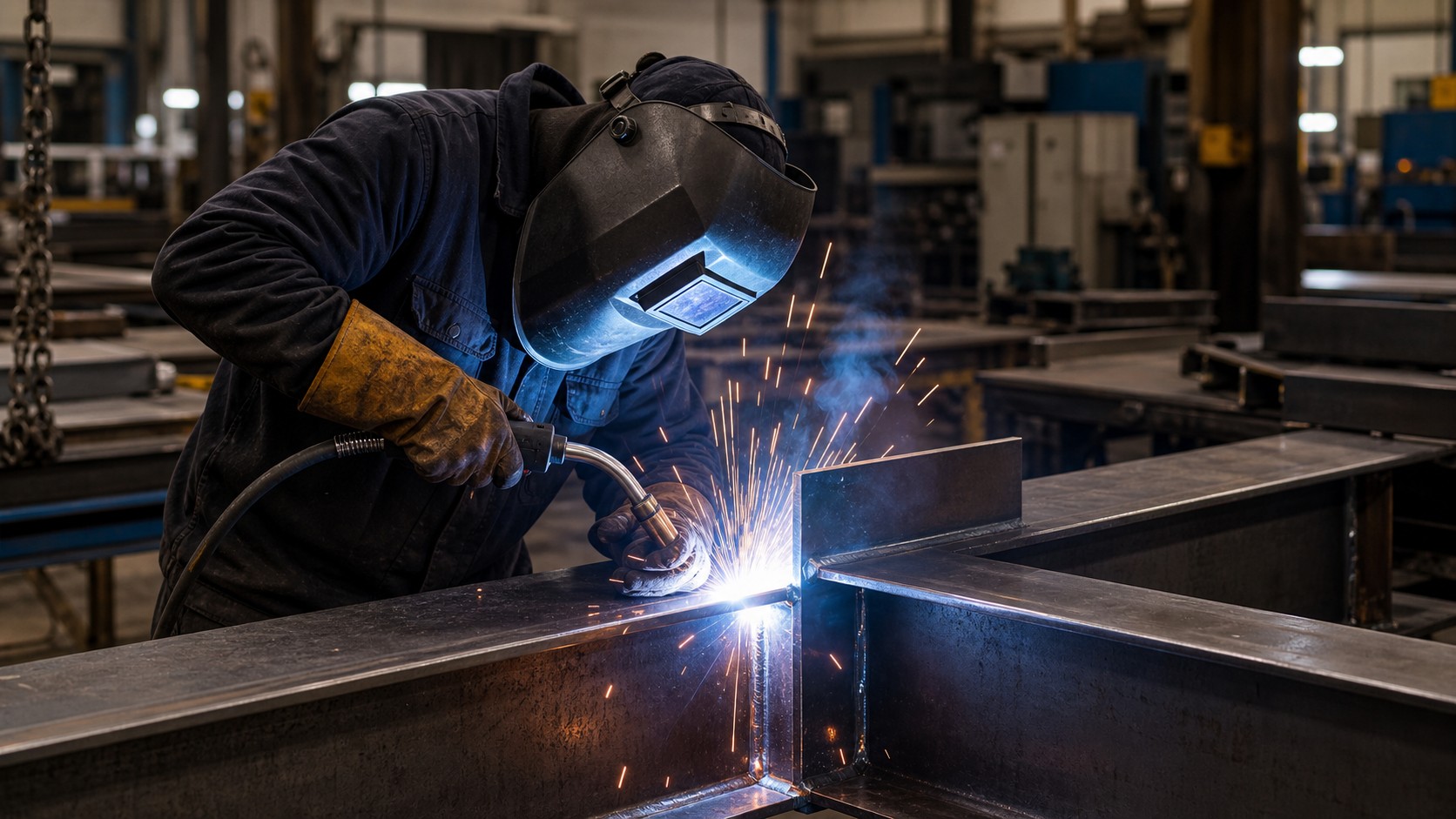
MIG welding, formally known as Gas Metal Arc Welding (GMAW), feeds a continuous solid wire electrode through a gun into the weld puddle while a shielding gas, typically CO2 or an argon-CO2 mix, protects the arc. It is the most common process in production fabrication shops for carbon steel and stainless steel, prized for speed and consistency.
MIG welding is the workhorse of the production fabrication floor. The process uses a constant-voltage power source and a wire feeder that continuously drives electrode wire into the arc. The welder controls the gun position and travel speed; the machine handles wire feed rate and voltage. This makes MIG faster to learn and faster to run than TIG on most structural and general fabrication applications.
Shielding gas keeps the weld puddle free of atmospheric contamination. For carbon steel, shops typically use a CO2-argon blend such as 75% argon / 25% CO2 (C25), which balances penetration, spatter level, and cost. For stainless steel, a tri-mix of argon, helium, and CO2 (or a low-CO2 blend) is common to maintain corrosion resistance in the weld zone. Straight CO2 is cheaper but produces more spatter and a rougher bead.
MIG welding produces some spatter, small beads of expelled molten metal that land near the weld. On cosmetic parts, spatter is ground or wire-brushed before powder coating or paint. On structural parts, minor spatter is typically acceptable. Our welding service uses MIG as the primary process for most steel fabrication, with the process selection confirmed when we review your print.
TIG Welding: Precision and Clean Results
TIG welding, or Gas Tungsten Arc Welding (GTAW), uses a non-consumable tungsten electrode to create the arc and adds filler metal separately via a hand-held rod. The process is slower than MIG but gives the welder precise control over heat input and bead shape, making it the preferred choice for thin gauge, stainless, aluminum, and joints where appearance matters.
TIG welding gives the welder two independent controls: the arc (created by the tungsten electrode) and the filler metal (added by hand with a separate rod). This two-handed process requires more skill and runs slower than MIG, but the payoff is a level of control that MIG cannot match. The bead can be made very narrow or wide, the heat input can be adjusted mid-pass with a foot pedal, and spatter is essentially zero.
Stainless steel is one of the most common TIG applications in fabrication shops. Stainless is sensitive to heat input: too much heat causes sugaring (oxidation on the back side of the weld) and can reduce corrosion resistance in the heat-affected zone. The corrosion behavior that makes stainless worth protecting during welding is one reason to understand how galvanized, stainless, and mild steel differ before you spec a material. TIG’s controlled, low-spatter arc and the option to purge the back side of the joint with argon gas make it the standard for high-quality stainless fabrication.
Aluminum TIG welding uses alternating current (AC) rather than the direct current used on steel. The AC arc provides a cleaning action that removes the aluminum oxide layer that naturally forms on the surface. Properly executed TIG welds on aluminum are strong, clean, and aesthetically appropriate for visible architectural or consumer-facing components.
Thin-gauge sheet metal joints, food-grade equipment, aerospace components, and any weld that will be visible in the finished product are common TIG applications. If your parts need a clean weld that won’t require significant post-weld grinding or dressing, TIG is the right conversation to have with your fabricator.
Flux-Core and Stick Welding: Heavy and Structural Work
Flux-Core Arc Welding (FCAW) uses a hollow wire with flux inside the core, producing its own shielding without requiring an external gas supply. Stick welding (SMAW) uses a consumable coated electrode. Both processes tolerate outdoor conditions, dirty or primed surfaces, and heavy plate better than MIG or TIG, making them standard for structural and field applications.
Flux-core welding can run in two modes: gas-shielded (FCAW-G, which adds an external shielding gas for cleaner welds) and self-shielded (FCAW-S, which relies entirely on flux). Self-shielded flux-core is used outdoors or in windy environments where external shielding gas would be blown away. The process deposits weld metal quickly and is well suited to thick sections, structural connections, and high-deposition passes on heavy plate.
Stick welding (Shielded Metal Arc Welding, SMAW) uses a coated electrode that acts as both the filler metal and the source of shielding flux. The electrode is clamped in a holder and touched to the workpiece to start the arc. Stick is slower than MIG or flux-core, but it works on rusty or painted surfaces, outdoors, in confined spaces, and in the field, where a wire feeder and gas cylinder aren’t practical. For heavy structural repair, pipeline work, and field fabrication, stick remains a relevant process.
In a shop environment, MIG handles most production welding on structural components. Flux-core comes out when a job calls for high-deposition passes on thick plate, for example heavy base plates, equipment frames, or structural weldments where travel speed and deposition rate matter more than bead appearance.
Choosing the Right Weld Process for Your Parts
Selecting the right welding process means matching material type, thickness, joint design, visual requirements, production volume, and any applicable welding codes. The table below gives a quick reference. For most fabricated steel structures and enclosures, MIG is standard. TIG enters the picture for stainless, aluminum, thin gauge, or where weld appearance matters.
| Process | Best For | Typical Materials | Relative Speed | Weld Finish |
|---|---|---|---|---|
| MIG (GMAW) | Production fabrication, structural, enclosures | Carbon steel, stainless steel | Fast | Good; minor spatter cleanup |
| TIG (GTAW) | Thin gauge, visible joints, precision | Stainless, aluminum, exotic alloys | Slow | Excellent; near-zero spatter |
| Flux-Core (FCAW) | Heavy plate, high-deposition structural | Carbon steel, low-alloy steel | Fast to very fast | Rough; requires slag removal |
| Stick (SMAW) | Field welding, repair, heavy structural | Carbon steel, low-alloy, some stainless | Moderate | Rough; slag removal required |
When you send a print or request a quote, your fabricator will note the material, thickness, joint type, and any code requirements. AWS D1.1 (Structural Welding Code for Steel) and AWS D1.6 (Stainless Steel) are common references for structural weldments. If your application requires a specific welding procedure specification (WPS) or qualified procedure, make that clear in your RFQ so the shop can confirm their capability before quoting.
Weld Quality and Structural Integrity
Weld quality starts before the arc is struck: correct joint fit-up, proper material prep, the right filler metal, and correct preheat on heavy sections all determine whether the finished weld is sound. Visual inspection catches most common defects. Qualified, experienced welders working to a defined procedure are the foundation of consistent weld quality in a production shop.
A structurally sound weld requires more than just striking an arc in the right place. Joint fit-up must be within tolerance; gaps that are too wide or too narrow change the weld cross-section and can introduce porosity or lack of fusion. Surfaces must be clean of mill scale, oil, or coating at the weld zone. For heavy carbon steel sections above roughly 1 inch thick, preheat is often required to slow the cooling rate and reduce the risk of hydrogen-induced cracking.
Filler metal selection matters as much as process selection. The filler’s mechanical properties (yield strength, tensile strength, impact toughness) must meet or exceed the base metal requirements. For structural applications, mismatched filler can result in welds that are technically complete but mechanically undermatched for the design load.
Visual inspection is the first and most common method of weld quality verification. Trained inspectors look for surface porosity, undercut, cracks, incomplete fusion at the toes of the weld, and unacceptable profiles. For more critical applications, nondestructive testing methods such as ultrasonic testing (UT) or dye penetrant testing (PT) can detect sub-surface or surface-opening defects not visible to the eye.
Working with experienced welders who understand fit-up requirements, preheat needs, and the behavior of the specific materials in play is the most reliable foundation for weld quality. The shop’s ability to hold fit-up tolerances before welding, not just after, is a reliable indicator of overall quality discipline.
Welding at Paragon: Part of a Full-Service Shop
Paragon Metal Fabricators has provided welding as part of complete part fabrication for more than 40 years. Our welding capability works alongside laser cutting, forming, rolling, and powder coating in a single facility in Hebron, Kentucky, serving Northern Kentucky and Greater Cincinnati. We weld carbon steel, stainless steel, and aluminum across a wide range of structural and precision applications.
Our welding service covers MIG and TIG welding for the majority of our fabricated parts. We weld carbon steel, stainless steel, and aluminum. When a job requires flux-core for heavy plate or structural applications, we have that capability in-house as well. Our welders bring experience working from engineering prints across many industries: agriculture, industrial equipment, material handling, enclosures, architectural steel, and more.
After welding, many parts move directly to our powder coating operation for a durable finish, or to final inspection before shipping. We also offer grinding and finishing between operations when the application requires a smooth weld profile. Having all of these steps in one building reduces the time parts spend in transit and keeps the communication simple.
For customers who want to understand what finishing options follow welding, or who need guidance on material and process selection, the team at Paragon is happy to work through your design before quoting. See our full fabrication services list or contact us to discuss your next project. You can also call us at 1-800-467-0121.
Get a Welding Quote
MIG, TIG, structural. Send us your drawings and we’ll confirm the right process and quote your job.
or call 1-800-467-0121
Frequently Asked Questions
What is the difference between MIG and TIG welding?
MIG welding (GMAW) uses a continuously fed wire electrode and is faster and better suited to production fabrication on carbon and stainless steel. TIG welding (GTAW) uses a non-consumable tungsten electrode and a separately added filler rod, giving the welder precise control over heat and bead shape at the cost of speed. TIG is used for thin gauge, aluminum, precision joints, and visible welds where appearance matters.
Which welding process is used for stainless steel?
Both MIG and TIG are used on stainless steel, depending on the application. TIG is preferred for thin gauge, high-visibility, or precision stainless work because of its controlled heat input and clean bead. MIG with a suitable stainless wire and low-CO2 shielding gas is used for thicker stainless sections in production environments where speed matters more than a perfect bead appearance.
Can you weld aluminum in a metal fabrication shop?
Yes. Aluminum is welded using TIG (with AC current) or MIG (with a push-pull feeder designed for aluminum wire). TIG is more common for aluminum fabrication in a shop setting because it gives better control over the aluminum oxide layer and heat input. The welder and equipment must be set up specifically for aluminum, as the process differs significantly from steel welding.
What does “certified welder” mean for structural work?
A certified welder has passed a qualification test demonstrating the ability to produce sound welds to a specific welding procedure specification (WPS) under a recognized standard such as AWS D1.1. Certification is welder-specific and procedure-specific: a welder qualified for one process, position, and material may need separate qualification for a different combination. For structural steel applications governed by building codes or client requirements, certified welders and documented WPS are typically required.
Does weld quality affect part performance?
Yes, significantly. A weld with porosity, cracks, incomplete fusion, or undersized cross-section can fail at loads well below the design capacity. Proper fit-up, filler metal selection, preheat where required, and welder skill all directly affect the mechanical performance of the weld joint. For structural, pressure-containing, or safety-critical applications, weld quality inspection is not optional.