Materials / Metal Fabrication Guide
Galvanized vs Stainless vs Mild Steel: Which Should You Use for Your Parts?
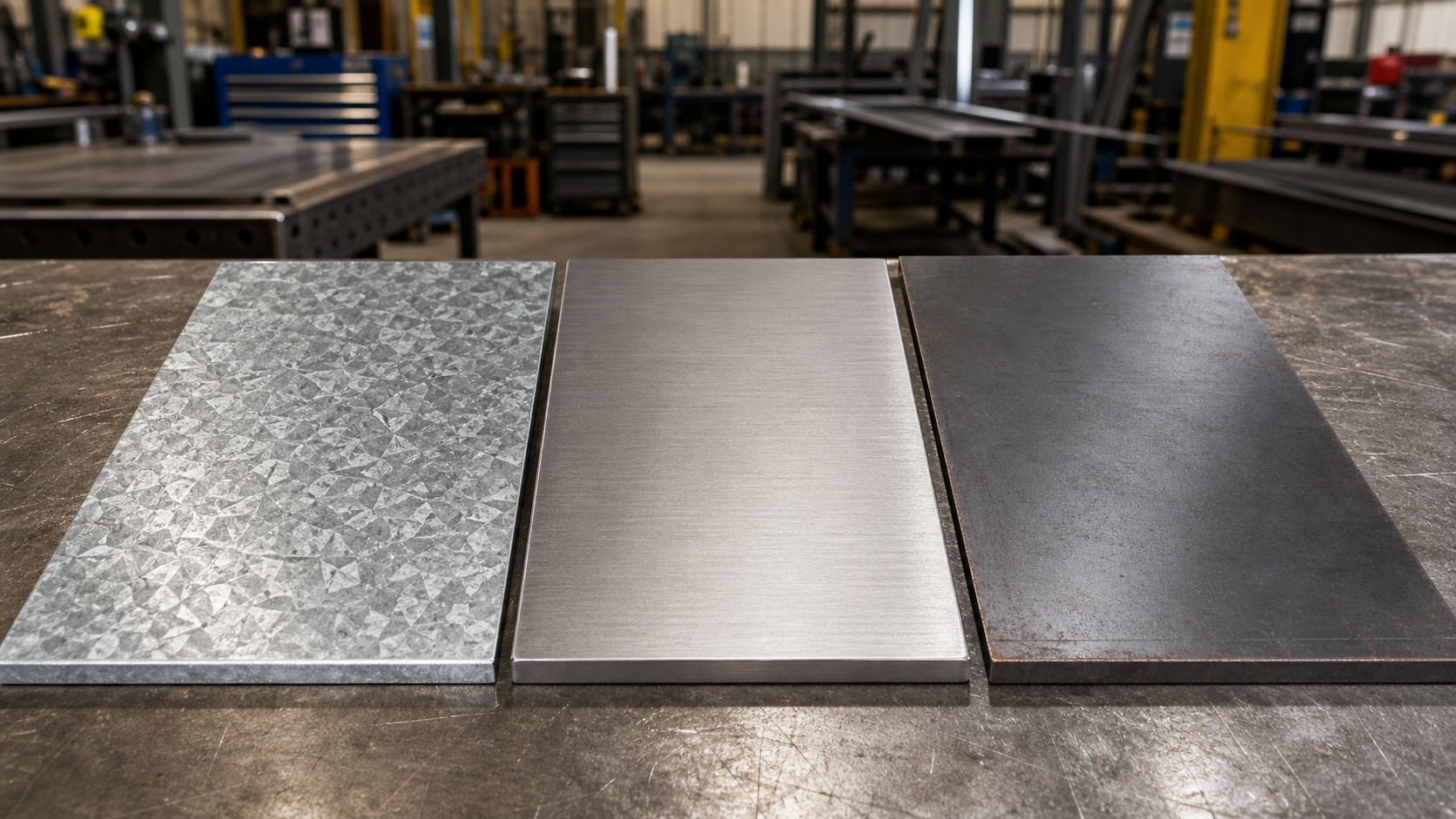
Mild steel is the lowest-cost, most weldable option for structural and general parts painted or powder coated after fabrication. Galvanized adds a zinc coating for outdoor and agricultural corrosion protection at low cost. Stainless steel provides superior long-term corrosion resistance for food-grade, chemical, and demanding outdoor applications, at higher material cost.
or call 1-800-467-0121
Mild Steel: The Workhorse of Fabrication
Mild steel, typically A36 or A572 grade, is the most widely used material in structural and general metal fabrication. It offers the best combination of low material cost, easy weldability, and compatibility with all common cutting and forming processes. It requires a surface treatment, such as paint or powder coating, for corrosion protection in most service environments.
Mild steel is the default choice for most fabricated parts in North American manufacturing, construction, and industrial equipment. The term “mild steel” refers to low-carbon steel with a carbon content typically below 0.30%, which gives it excellent ductility and weldability. It bends without cracking, cuts cleanly on a laser or waterjet, and welds well with standard MIG or TIG processes and commonly available filler metals.
ASTM A36 is the most common structural steel grade for general fabrication. A572 grade 50 is a higher-strength option with a higher yield strength, used when load requirements justify the slightly higher cost. Both grades are available in plate, sheet, angle, channel, tube, and pipe from most steel service centers. Lead times are typically short, and material cost is the lowest of the three steel categories discussed here.
The key limitation of mild steel is that it rusts. Without a surface treatment, mild steel will begin to oxidize in humid or outdoor environments quickly. This is why most mild steel fabricated parts get powder coated, painted, or primed before delivery. Our laser cutting and forming operations handle mild steel as the primary production material, and most of those parts finish with powder coating before shipping to customers.
For structural applications, frames, enclosures, equipment bases, agricultural implements, and most industrial parts where the surface can be coated, mild steel is the correct starting point. It’s the easiest material to source, the most predictable to fabricate, and the least expensive per pound.
Galvanized Steel: Corrosion Protection at Low Cost
Galvanized steel is mild steel coated with a layer of zinc, applied by hot-dip galvanizing or electrogalvanizing. The zinc coating acts as a sacrificial barrier, corroding before the underlying steel does. It suits outdoor, agricultural, and construction applications where corrosion protection is needed without the cost of stainless. Welding galvanized steel requires proper ventilation due to zinc fumes.
Hot-dip galvanizing is the most common galvanizing method for structural steel. The fabricated steel part is cleaned, fluxed, and dipped in a bath of molten zinc at approximately 450 degrees Celsius. The zinc metallurgically bonds to the steel surface, forming a layered coating that is far more durable than paint alone. Hot-dip galvanizing is used on highway guardrails, utility poles, agricultural equipment, and outdoor structural components that need to survive decades of weather exposure with minimal maintenance.
Electrogalvanizing (also called EG or electro-galvanized) applies a thinner zinc layer by electrochemical deposition. Sheet steel purchased as “galvanized” from a service center is usually electrogalvanized or hot-dip coated in coil form. This material is common for HVAC ductwork, agricultural panels, and any sheet metal product that needs moderate corrosion resistance before or after fabrication.
The zinc coating works through two mechanisms: it acts as a physical barrier that keeps moisture and oxygen away from the steel, and it acts sacrificially, meaning zinc corrodes preferentially and protects the steel underneath even at scratches or cut edges. This sacrificial action is one reason galvanized steel outperforms painted mild steel in corrosive environments: a scratch through paint exposes bare steel, but a scratch through galvanizing still has zinc available to protect the nearby steel.
Welding galvanized steel requires care. When the zinc coating burns off at the weld zone, it produces zinc oxide fumes that are harmful if inhaled. Welding galvanized steel must be done with proper exhaust ventilation, respiratory protection, and awareness that the weld zone will lose its galvanized coating and may need touch-up with cold galvanizing compound or zinc-rich paint. You can powder coat over properly prepared galvanized steel, but adhesion preparation is critical.
Stainless Steel: Long-Term Corrosion Resistance
Stainless steel contains at least 10.5% chromium, which forms a passive oxide layer that resists corrosion without any surface coating. Grade 304 is the standard for food-grade, architectural, and general corrosion-resistant applications. Grade 316 adds molybdenum for resistance to chlorides and acids, making it the choice for marine, chemical processing, and coastal environments.
The corrosion resistance of stainless steel comes from the chromium in the alloy. Chromium reacts with oxygen in the environment to form a thin, stable chromium oxide layer on the surface. This passive layer is self-healing: if the surface is scratched, the chromium oxide reforms in the presence of oxygen. No external coating is required for corrosion protection in most environments, which is a significant advantage over mild or galvanized steel for applications where maintenance is difficult or where a coating failure would be costly.
Grade 304 (18% chromium, 8% nickel) is the most common stainless grade in fabrication. It handles food and beverage processing, pharmaceutical equipment, restaurant equipment, architectural panels, and general outdoor applications without issue. It is not immune to corrosion in chloride-rich environments: exposure to saltwater or high-chloride cleaning chemicals can cause pitting corrosion in 304 over time.
Grade 316 adds 2-3% molybdenum to the alloy, which significantly improves resistance to chlorides and acids. For coastal installations, chemical processing equipment, marine hardware, or anything exposed to de-icing salt, 316 is the right choice over 304. The material cost premium over 304 is real but modest compared to the long-term maintenance cost of using the wrong grade in a harsh environment.
Stainless steel is harder to cut and weld than mild steel. Laser cutting stainless typically uses nitrogen as the assist gas rather than oxygen (which would oxidize the cut edge), which increases operating cost. TIG welding is commonly preferred for stainless to control heat input and avoid sensitization of the heat-affected zone. See our laser cutting service and welding service pages for more on how we handle stainless.
Side-by-Side: Choosing the Right Material
The table below compares mild steel, galvanized steel, and stainless steel across the properties that matter most for fabricated parts. Use it as a starting point; your specific application, environment, and budget will refine the choice. When in doubt, describe the application to your fabricator and ask for a recommendation before specifying a material grade.
| Property | Mild Steel | Galvanized Steel | Stainless Steel (304/316) |
|---|---|---|---|
| Material Cost | Lowest | Low to moderate (mild + coating cost) | Higher (2-4x mild steel per lb) |
| Corrosion Resistance | Poor without coating | Good; zinc sacrificial protection | Excellent; self-healing passive layer |
| Weldability | Excellent | Good; zinc fumes require ventilation | Moderate; requires skill and proper filler |
| Tensile Strength | 58-80 ksi (A36/A572) | Similar to base mild steel grade | 70-90 ksi (304/316 annealed) |
| Weight | ~490 lb/ft³ | Similar to mild steel | ~490 lb/ft³ (very close to mild) |
| Surface Treatment Needed? | Yes (paint or powder coat) | Usually not; can add powder coat | No; optional for aesthetics only |
| Common Applications | Structural frames, enclosures, equipment bases | Outdoor/ag panels, HVAC, construction | Food-grade, chemical, marine, architectural |
Material Choice Affects Fabrication Cost and Process
Your material choice affects more than purchase price. It determines which laser assist gas is needed, how the part must be prepped for welding, which finishing steps apply, and how long fabrication takes. Stainless requires nitrogen-assist laser cutting, careful weld filler selection, and no painting. Galvanized requires ventilation controls during welding. Understanding these downstream effects helps you make a cost-complete decision.
Choosing stainless steel over mild steel adds cost at several points in the fabrication sequence. Laser cutting stainless uses nitrogen assist gas rather than oxygen, which costs more to run and is slower on thicker sections. Stainless work hardening means more tool wear during any secondary machining. Welding requires stainless-specific filler wire and typically TIG process for quality work. These factors can add 30-60% to fabrication cost over equivalent mild steel work, before considering the material price difference.
Galvanized steel brings its own process considerations. The zinc coating creates fume hazards during welding that require dedicated exhaust ventilation and respiratory protection. If the part is to be powder coated after welding, the galvanized surface must be properly prepared (mechanically abraded or chemically treated) to get adequate adhesion. Pre-galvanized sheet can also introduce dimensional variation in tight-tolerance bends due to the coating thickness. See our guide to metals that can be laser cut and the sheet metal gauge guide for more on how material type and thickness interact with the cutting process.
- Mild steel + powder coat: Lowest total cost for indoor or covered outdoor applications where periodic recoating is acceptable.
- Galvanized + no coat: Best value for outdoor structural applications where long-term low-maintenance matters and aesthetics are secondary.
- Galvanized + powder coat: Dual-layer protection for high-corrosion environments; requires proper prep between layers.
- Stainless 304: Best for food contact, medical, pharmaceutical, or architectural applications where appearance and cleanability matter.
- Stainless 316: Required for chloride, acid, or marine exposure where 304 would pit over time.
Sourcing and Specifying the Right Grade
Tell your fabricator the application environment and service conditions, not just the material name. “Stainless” on a drawing could mean 304, 316, 310, 430, or a dozen other grades with very different properties and costs. Likewise, “galvanized” could mean hot-dip or electrogalvanized. The right conversation before quoting avoids expensive material substitutions or field failures after delivery.
The most common material specification mistake in fabrication is under-specifying the grade. A drawing that says “stainless steel” without a grade leaves the fabricator to default to whatever is in stock, which may or may not suit the application. For food-grade equipment, specify 304 at minimum and 316 if chloride cleaning agents are used. For structural or decorative work with no corrosive exposure, 430 (ferritic stainless, no nickel) may be an option at lower cost than austenitic grades.
For galvanized steel, the coating weight matters for long-term performance. ASTM A123 governs hot-dip galvanizing of structural steel and specifies minimum coating thicknesses by material category. If your galvanized part must meet A123 (common for highway, utility, or government applications), say so on the drawing and in your RFQ.
When you’re not sure which grade to specify, describe the application, the environment it will operate in, any cleaning or chemical exposure, and the expected service life, and ask your fabricator for input before finalizing the drawing. We review this kind of question regularly at Paragon. Our team can often suggest a cost-saving alternative or flag a specification that might cause a problem in service. Use our RFQ checklist to make sure your quote request includes the information a fabricator needs to get your material specification right. Contact us to discuss your next project or call 1-800-467-0121.
Need Help Choosing a Material?
Describe your application and we’ll help you select the right steel grade before you finalize your drawing. No obligation.
or call 1-800-467-0121
Frequently Asked Questions
When should I choose stainless steel over mild steel?
Choose stainless steel when your application requires corrosion resistance without a paint or powder coat, when parts contact food, beverages, or pharmaceuticals, when the environment includes chlorides or harsh cleaning chemicals, or when long service life with minimal maintenance is required. Mild steel with powder coating is typically the better value for indoor, structural, or general industrial applications where the coating can be maintained.
Can I weld galvanized steel?
Yes, but with important precautions. When the zinc coating burns during welding, it produces zinc oxide fumes that are hazardous to breathe. Welding galvanized steel requires strong exhaust ventilation and appropriate respiratory protection. The weld zone will lose its galvanized coating, so the bare steel at and around the weld must be treated with cold galvanizing compound, zinc-rich paint, or similar after welding to maintain corrosion protection.
Is stainless steel stronger than mild steel?
Annealed 304 and 316 stainless steel have tensile strengths similar to mild steel A36 (roughly 70-90 ksi versus 58-80 ksi for A36/A572). Stainless work-hardens more rapidly than mild steel, so formed stainless parts can be considerably stronger in the work-hardened condition. For most structural applications, the strength difference between mild steel and common austenitic stainless is not the deciding factor; corrosion resistance and cost drive the choice.
Can you powder coat galvanized steel?
Yes, but surface preparation is critical. Galvanized steel must be mechanically abraded, chemically treated with a conversion coating, or both, before powder coating to achieve adequate adhesion. Powder applied directly to a smooth galvanized surface without preparation will peel over time. When done correctly, powder-coated galvanized steel provides excellent dual-layer corrosion protection: the zinc protects the steel and the powder coat protects the zinc.