
Laser Cutting / Northern Kentucky & Greater Cincinnati
What Metals Can Be Laser Cut? Materials and Thickness
Fiber lasers cut carbon steel, mild steel, stainless steel (304 and 316), aluminum, and most structural alloys cleanly and precisely. Carbon steel handles up to about one inch thick using oxygen assist gas. Stainless cuts to around half an inch with nitrogen assist. Aluminum cuts to about one inch on fiber systems. Copper and brass are highly reflective and much harder to laser cut.
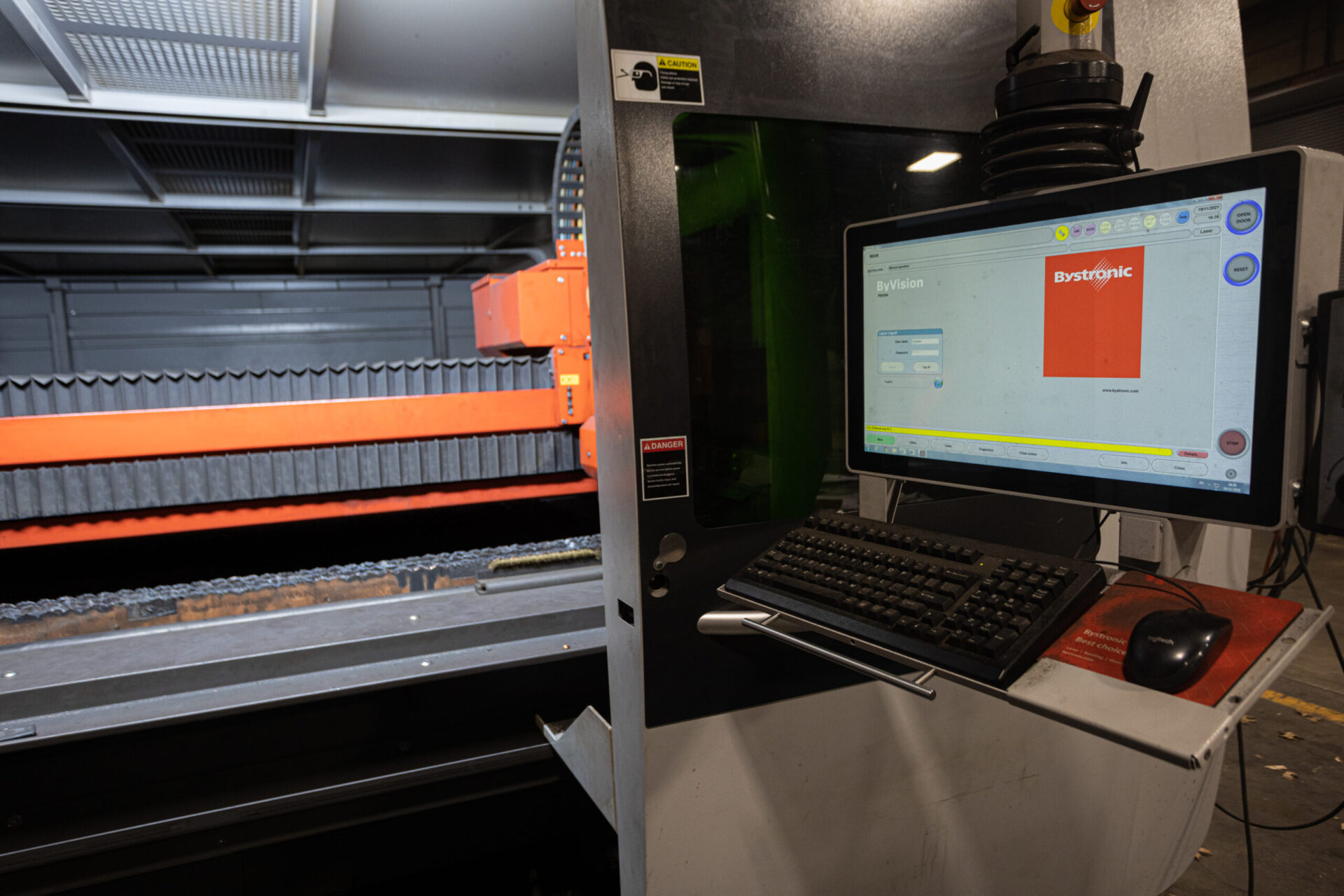
Which Metals Can Be Laser Cut?
Fiber laser cutting works well on carbon steel, mild steel, stainless steel, aluminum, galvanized steel, and most common structural alloys. These metals absorb the laser wavelength efficiently, produce clean cuts with tight tolerances, and handle a wide range of thicknesses. Highly reflective metals like copper and brass present significant challenges and are often better processed by plasma or waterjet.
The key variable is how well a metal absorbs the laser beam’s energy. Fiber lasers operate at a 1,070-nanometer wavelength, which most ferrous and many non-ferrous metals absorb well. When the beam hits the material, it melts and vaporizes the metal along the cut path while an assist gas (oxygen or nitrogen, depending on the application) blows the molten material out of the kerf.
For most structural, enclosure, and bracket fabrication work, the answer to “can this be laser cut?” is yes. The more important question is usually thickness. Every material has a practical maximum thickness that depends on the laser’s power output, the assist gas selected, and the cut quality required. Beyond those limits, the beam struggles to penetrate consistently, edge quality degrades, and process speed drops to the point where other processes become more practical.
Our laser cutting service handles flat sheet and plate across all the standard materials covered below. For structural profiles like square tube, round tube, and angle, see our tube laser cutting page, which covers the same material list in structural form.
Carbon Steel: The Workhorse Material
Carbon and mild steel are the easiest and most cost-effective metals to laser cut. Oxygen assist gas reacts with the iron in the steel to boost cutting speed and enable greater thickness penetration. Fiber lasers cut carbon steel up to approximately one inch thick with clean edges and tight tolerances. The oxygen-assisted cut leaves a thin oxide layer on the edge, which is normal and typically removed during finishing.
Mild steel (1008, 1018, 1020) and structural grades like A36 are the most commonly laser-cut metals in fabrication shops. They’re available in sheet, plate, and structural profile stock, they weld cleanly, and they take powder coat and paint without issue. For anything from thin 24-gauge sheet metal to half-inch plate, laser cutting is almost always the right first choice on carbon steel.
As carbon steel plate gets thicker, oxygen assist becomes more critical. The exothermic reaction between the oxygen and the steel’s iron content adds energy to the cut zone, helping the laser power penetrate deeper into the material. At one inch and above, the process starts to require significantly more power and slower speeds to maintain edge quality. At those thicknesses, plasma cutting may offer better economics, particularly if tolerance requirements are less stringent.
One practical note: oxygen-assisted carbon steel cuts produce an oxide layer (a darkened, slightly rough surface) on the cut edge. If the part will be welded, painted, or powder coated, this is a non-issue. If raw edge appearance matters for the application, that’s worth calling out in your RFQ so we can advise on the best approach.
Stainless Steel: Clean Edges with Nitrogen Assist
Stainless steel, primarily grades 304 and 316, cuts well on fiber laser systems using nitrogen as the assist gas. Nitrogen is inert, so it doesn’t react with the chromium in the stainless alloy, leaving a bright, oxide-free edge that often requires no secondary finishing. The practical thickness limit for stainless on most fiber systems is around half an inch, though higher-wattage machines can push to three-quarters of an inch or more.
The choice of nitrogen assist for stainless is intentional. Using oxygen on stainless would create a heavy discolored oxide layer on the cut edge, potentially compromising the corrosion resistance that makes stainless the specified material in the first place. Nitrogen keeps the cut zone inert, the edge stays bright and clean, and the corrosion-resistant chromium oxide layer remains intact.
Stainless has higher tensile strength than mild steel, which means it takes more laser power to achieve the same cut speed and quality at a given thickness. A machine that rips through 3/8-inch mild steel quickly may need significantly more time on the same thickness of 304 stainless. Quoting accounts for this, so stainless parts typically cost more per piece than equivalent mild steel parts, even before the material cost premium.
Grade 316 stainless, with its molybdenum addition for enhanced corrosion resistance, cuts the same way as 304 on a laser. The difference shows up in the material cost and in the application: 316 is specified where 304 isn’t sufficient, such as marine environments, chemical processing, and pharmaceutical or food equipment.
Aluminum: Fiber Laser, Not CO2
Aluminum cuts well on fiber laser systems because aluminum efficiently absorbs the fiber wavelength. Common alloys like 6061, 5052, and 3003 cut cleanly with nitrogen assist, producing smooth bright edges. Practical thickness limits reach approximately one inch on fiber systems. Older CO2 lasers struggled with aluminum due to its high reflectivity at the CO2 wavelength; fiber laser resolved this problem.
Aluminum’s combination of low density, good strength-to-weight ratio, and corrosion resistance makes it a common specification for aerospace brackets, automotive parts, enclosures, and any application where weight matters. All of these can be laser cut from sheet or plate stock, then formed, machined, or welded as needed.
The main challenge with aluminum on a laser is its high thermal conductivity. Aluminum dissipates heat quickly, which means the laser must deliver energy fast enough to melt the material before it conducts away. Higher-wattage lasers handle this better, which is why maximum thickness capability scales more noticeably with machine power for aluminum than for steel.
Nitrogen assist is the standard for aluminum laser cutting because it keeps the cut zone oxide-free and produces the cleanest edge finish. For anodized aluminum, it’s worth noting that the anodized layer will be removed along the cut edges, exposing bare aluminum. If re-anodizing the full part post-cut isn’t feasible, design the part so cut edges aren’t in a visible or corrosion-critical location, or specify a finish that covers the edge.
Thickness Limits by Material
Practical laser cutting thickness limits vary by material and machine wattage. As a general reference: carbon steel cuts to around one inch (O2 assist), stainless steel to roughly half an inch (N2 assist), and aluminum to about one inch (fiber, N2 assist). Higher-wattage systems, such as 8 kW or above, push these limits, reaching approximately 30 mm on steel and stainless and 25 mm on aluminum.
| Material | Typical Max (Standard Wattage) | High-Wattage Limit (8 kW+) | Assist Gas | Edge Condition |
|---|---|---|---|---|
| Carbon / Mild Steel | ~1 inch (25 mm) | ~30 mm | Oxygen (O2) | Oxide layer present; remove before painting or welding if required |
| Stainless Steel (304/316) | ~1/2 inch (12 mm) | ~30 mm | Nitrogen (N2) | Bright, oxide-free; often no secondary finishing needed |
| Aluminum (6061, 5052) | ~1 inch (25 mm) | ~25 mm | Nitrogen (N2) | Bright, clean; anodized layer removed at cut edges |
| Galvanized Steel | ~3/8 inch (10 mm) | ~12 mm | Nitrogen (N2) | Zinc coating vaporized at cut; zinc fumes require ventilation |
| Copper / Brass | Difficult (highly reflective) | Possible at very low speeds; process risk | N2 or O2 | Consider plasma or waterjet instead |
These limits are practical guides, not absolute hard stops. Every job depends on the specific machine, the part geometry (hole-to-edge ratios, feature sizes), and the required cut quality. If you have a material or thickness you’re not sure about, include it in your RFQ and we’ll give you a direct answer on feasibility and lead time.
What Affects Maximum Cutting Thickness
Three main factors set the practical thickness ceiling for laser cutting: laser power (wattage), assist gas type and pressure, and cutting speed. Higher wattage delivers more energy per unit time to melt thicker material. The right gas choice (O2 for carbon steel, N2 for stainless and aluminum) keeps the cut zone clean and supports penetration. Lower speed allows more dwell time at each point for thicker cuts.
Laser power. Wattage is the primary lever. A 4 kW fiber laser handles most common sheet metal thicknesses comfortably. An 8 kW or 12 kW machine pushes maximum thickness limits significantly, reaching 30+ mm on structural steel. Higher wattage also allows cutting at faster feed rates on thinner material, which reduces cost per part on high-volume jobs.
Assist gas pressure and purity. At higher thicknesses, gas pressure becomes more important for blowing molten material out of the kerf efficiently. Too little pressure and the melt re-solidifies along the cut edge (dross). On stainless steel, high-pressure nitrogen at high purity (99.99%) is standard for clean bright cuts. On carbon steel with oxygen assist, controlled pressure is needed because too much oxygen at high cutting speeds can cause edge burning.
Feed rate. Cutting speed slows as thickness increases. A laser that cuts 14-gauge mild steel at 1,000 inches per minute may slow to 15 to 20 inches per minute on one-inch plate. Slower feed rates mean more machine time per square foot of material cut, which is reflected in the quote for thicker-material jobs.
Part geometry. Small interior features, tight holes, and acute corners become harder to hold with precision as thickness increases. Minimum feature size rules, such as keeping hole diameters at or above material thickness, become more important as you move into heavy plate. Our laser cutting DFM guide covers these considerations in detail.
Copper and Brass: The Reflective Metal Challenge
Copper and brass are highly reflective at laser wavelengths, which means they reflect a significant portion of the laser beam’s energy back toward the cutting head rather than absorbing it. This creates process instability, potential damage to the laser optics, and poor cut quality. For copper and brass, plasma cutting or waterjet cutting are typically safer, more consistent alternatives.
Modern fiber lasers handle copper and brass better than older CO2 systems, but the process is still significantly more challenging than on steel or aluminum. High-power fiber systems can cut thin copper and brass with specialized parameters, but the process requires close attention, slower speeds, and more frequent monitoring than standard materials. For thicker gauges, the risk-to-reward ratio shifts further toward alternative processes.
If your application specifies copper or brass, bring that to us during the quoting stage. We’ll assess the specific gauge and part geometry against what our laser system can reliably hold, and we’ll tell you honestly whether laser cutting is the right process or whether plasma or waterjet will give you a better result on that material.
For a side-by-side look at how laser cutting compares to waterjet on difficult materials and thick plate, see our laser cutting vs waterjet comparison page. The tradeoffs on edge quality, heat-affected zone, and material flexibility are relevant to any copper or brass application.
You can also compare laser to plasma on our sheet metal gauge guide, which covers common material thicknesses across steel, stainless, and aluminum in a single reference chart.
Not Sure If Your Material Is a Fit?
Send us your material spec, thickness, and part drawing. The Paragon team has 40+ years of laser cutting experience across carbon steel, stainless, and aluminum for manufacturers throughout Northern Kentucky, Greater Cincinnati, and the tri-state region. We’ll tell you exactly what we can do and how fast we can do it.
Frequently Asked Questions
Can you laser cut aluminum?
Yes. Fiber laser systems cut aluminum cleanly using nitrogen assist gas, which keeps the cut edge bright and oxide-free. Common alloys like 6061, 5052, and 3003 all cut well. The practical thickness limit on most fiber systems is around one inch. Aluminum’s high thermal conductivity means higher laser wattage helps significantly on thicker gauges. CO2 lasers struggle with aluminum; fiber laser resolved that limitation.
How thick can you laser cut steel?
On most fiber laser systems, carbon and mild steel cuts to approximately one inch thick using oxygen assist gas. Higher-wattage machines, such as 8 kW systems, reach around 30 mm (roughly 1.2 inches) on carbon steel. Stainless steel is more limited, typically up to about half an inch on standard systems, or roughly 30 mm on high-wattage equipment. Thickness beyond these ranges is often better handled by plasma or waterjet cutting.
Can lasers cut copper or brass?
Copper and brass are highly reflective at laser wavelengths and difficult to cut consistently with laser systems. Modern high-power fiber lasers can handle thin copper and brass under controlled conditions, but the process is significantly more challenging than steel or aluminum and carries risk of optic damage. For most copper and brass applications, plasma cutting or waterjet cutting delivers better results with less process risk and more consistent edge quality.
or call 1-800-467-0121