
Tube Laser Cutting / Tri-State Fabrication
What Is Tube Laser Cutting? Advantages and Applications
Tube laser cutting uses a fiber laser and a rotating chuck to cut pipe, square tube, rectangular tube, angle, and channel to precise lengths and shapes in a single pass. It replaces sawing, drilling, and milling with one automated operation, holding tolerances within thousandths of an inch on carbon steel, stainless, aluminum, and galvanized material.
What Is Tube Laser Cutting?
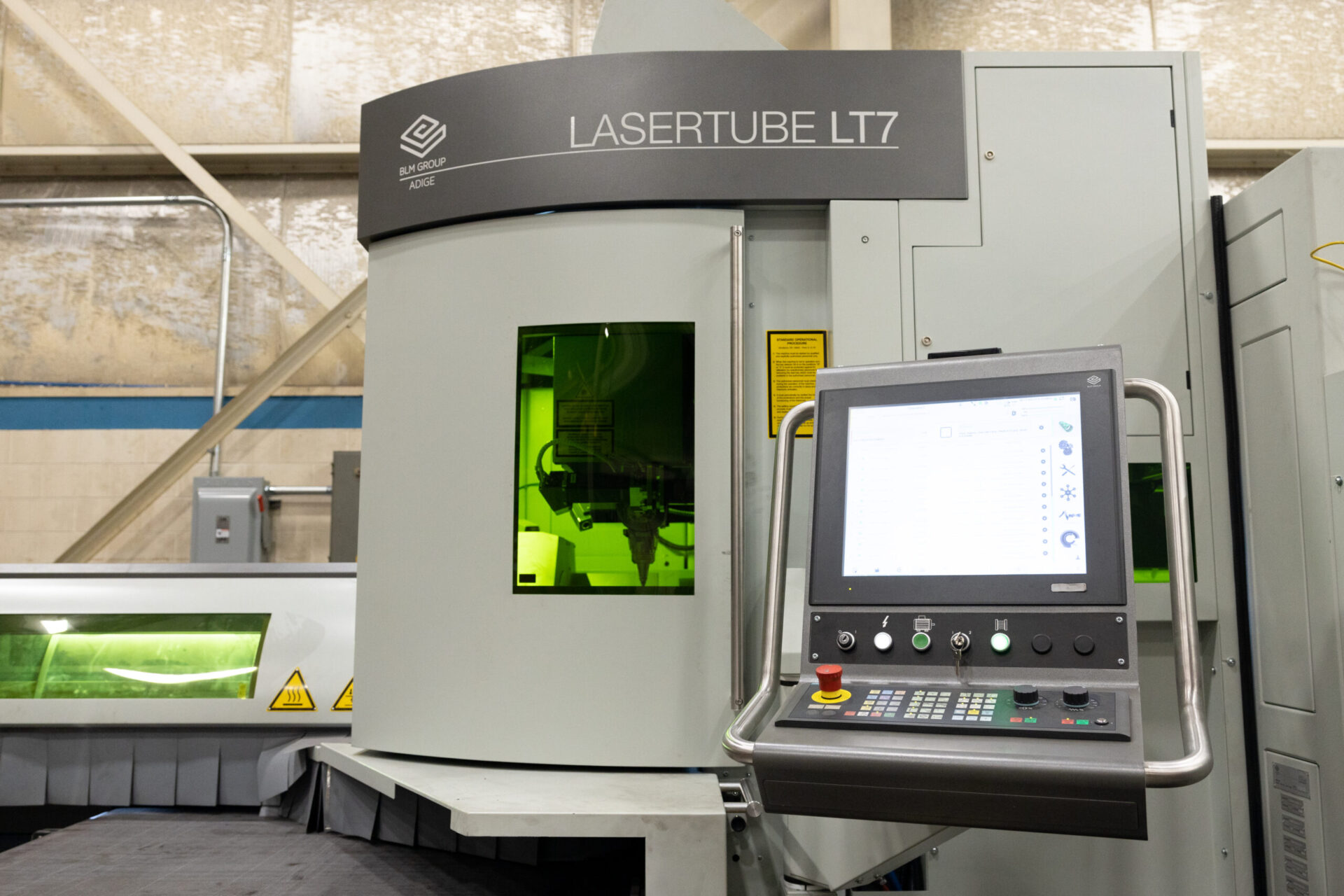
Tube laser cutting is a CNC fabrication process where a fiber laser head moves along a rotating structural section, cutting profiles, holes, slots, notches, and compound angles into the tube or pipe in a single automated setup. It handles pipe, square tube, rectangular tube, angle iron, and channel in one machine cycle.
The machine holds the structural section in a rotating chuck on one end and a steady-rest on the other. As the laser head travels the length of the part, the chuck rotates the workpiece to keep the laser perpendicular to the cut surface at every angle. That combination of linear travel and controlled rotation is what makes compound cuts, saddle cuts, and coped ends possible without secondary machining.
At Paragon, our tube laser cutting service brings this process to structural fabrication projects across Northern Kentucky and Greater Cincinnati. Whether you need a hundred identical brackets or a complex weldment requiring coped tube ends, the setup is CNC-driven from your files, so every part in the run matches the first.
How Is It Different from Sawing and Manual Cutting?
Traditional sawing cuts tube square at one angle per pass and leaves a rough edge that needs deburring. Tube laser cutting produces smooth, burr-free edges, cuts compound angles, adds holes and slots in the same pass, and holds tolerances within thousandths of an inch. It does in one cycle what sawing plus milling plus drilling takes hours to complete.
With a band saw or cold saw, you make a straight cut, then move the part to a drill press or mill for holes, then to a grinder for edge cleanup. Each transfer adds handling time, fixturing error, and labor cost. The cumulative tolerance stack from three separate setups is real, especially on a weldment where a dozen parts have to align.
Tube laser cutting collapses those steps into one. The kerf is narrow, roughly the width of the beam itself, so material waste stays minimal compared to milling, which removes far more stock to achieve the same geometry. Edge quality off the laser is smooth enough that most applications skip secondary finishing entirely.
What Are the Advantages of Tube Laser Cutting?
The main advantages are tight tolerances within thousandths of an inch, burr-free edges that often need no secondary finishing, a narrow kerf that keeps material waste low, and the ability to cut complex shapes, holes, and compound angles in a single automated pass without re-fixturing the part between operations.
Here is how those advantages add up on a real job:
- Accuracy: CNC-driven cuts hold position within thousandths of an inch, run after run. Weldments fit together without shimming or rework.
- Speed: A single-pass operation that cuts profiles, copes, and holes simultaneously is faster than the equivalent multi-step manual process, especially at volume.
- Minimal waste: The laser’s narrow kerf removes very little material relative to milling. Nesting software optimizes stock use further on longer bar runs.
- No secondary finishing required: Smooth edges come off the machine ready for welding or assembly on most jobs, which removes a labor step from the timeline.
- Consistency: Every part in a run is cut from the same CNC program. There’s no operator-to-operator variation that you’d see with layout and hand cutting.
- Design flexibility: Compound angles, slots, tabs, and notches that would require multiple setups on conventional equipment are cut in one pass.
For buyers, the practical result is a shorter lead time and a lower per-part cost on anything beyond the simplest straight cuts, particularly once you’re running production quantities.
What Shapes and Materials Can a Tube Laser Cut?
A tube laser cuts pipe (round), square tube, rectangular tube, angle iron, and structural channel. Compatible materials include carbon steel, mild steel, stainless steel (304 and 316), aluminum, and galvanized steel. The machine handles a range of wall thicknesses from light gauge up to heavier structural sections depending on the laser’s wattage.
The rotating chuck design is what enables the range of cross-sections. Round pipe is the simplest case, but the chuck can index to present any face of a square or rectangular section to the laser head. Angle iron and channel require specific fixtures or off-axis cutting strategies, which modern CNC tube lasers handle through software-defined orientation.
Material choices span the full structural steel spectrum. Carbon and mild steel are the highest-volume applications. Stainless 304 and 316 are common for food processing, pharmaceutical, and architectural work where corrosion resistance matters. Aluminum comes up in applications where weight is a factor, such as automotive components, furniture frames, and consumer products. Galvanized steel is cut routinely for agricultural and outdoor structural work.
Our flat laser cutting service handles sheet and plate in the same materials when the geometry is two-dimensional. For structural sections, the tube laser is the right tool.
What Industries and Parts Use Tube Laser Cutting?
Tube laser cutting is used across automotive (exhaust systems, roll cages, chassis frames), architectural and commercial construction (handrails, guardrails, structural columns, brackets), furniture and consumer products (tube frames, base assemblies), material handling, and agriculture. Any application that starts with structural tubing and requires precise geometry is a candidate.
In automotive fabrication, tube laser cutting is standard for exhaust manifolds and headers, roll cage tubing, suspension components, and chassis reinforcements. The ability to cope a tube end to match a curved surface or cut a precise hole for a bung fitting, all in one step, makes it the preferred process over manual layout and plasma cutting.
Architectural applications include commercial handrails and guardrail systems, steel stair stringers, storefront framing components, and decorative structural elements. Contractors specify laser-cut tube because the parts arrive ready to weld without site fitting.
Furniture and consumer products manufacturers use tube laser cutting for table and chair leg assemblies, retail display frames, gym equipment, and similar products where weld fit-up quality is visible in the finished product. Material handling equipment, conveyor framing, agricultural equipment, and structural weldments for construction machinery round out the common applications.
Why Choose Tube Laser Cutting at Paragon?
Paragon Metal Fabricators brings 40+ years of structural fabrication experience to every tube laser job. Our shop in Hebron, KY handles tube laser cutting alongside flat laser, waterjet, forming, welding, and powder coating under one roof, so your parts move from raw stock to finished, coated component without leaving our facility or adding vendor handoffs to your timeline.
That single-roof capability matters more than it might seem. When tube laser cutting is part of a larger weldment, the downstream operations (welding and powder coating) happen in the same building, under the same quality oversight, on the same timeline. You’re not coordinating between three vendors and hoping parts arrive in the right sequence.
We’ve served the tri-state region (Northern Kentucky, Greater Cincinnati, and surrounding Indiana) for over four decades as a family-owned shop. Our team works directly with your drawings and CAD files, and our DFM review catches issues before they become costly rework. If a tolerance is tighter than the process can hold reliably, we’ll tell you before we cut the first part, not after.
For structural tube jobs, visit our tube laser cutting service page for capability details. If your project includes tube and sheet, see our laser cutting service for flat geometry. For projects that also need comparison against other processes, see laser cutting vs. waterjet cutting and what metals can be laser cut.
Ready to Cut Your Tube Parts?
Send us your drawings or CAD files and our team will review them and turn a quote around fast. Paragon has served the tri-state region for 40+ years. We’re ready to get your job done.
Frequently Asked Questions
What materials can a tube laser cut?
A tube laser cuts carbon steel, mild steel, stainless steel (304 and 316), aluminum, and galvanized steel. It handles round pipe, square tube, rectangular tube, angle iron, and structural channel. Wall thickness range depends on the machine’s laser wattage; heavier structural sections are handled by higher-power fiber laser systems.
Is tube laser cutting more accurate than sawing?
Yes. Tube laser cutting holds tolerances within thousandths of an inch, compared to sawing, which produces rougher cuts requiring deburring and typically carries greater dimensional variation. The laser also adds holes, slots, and compound angles in the same pass that would need separate drilling and milling operations after sawing.
What tube sizes and shapes can you cut?
Tube laser machines handle round pipe, square tube, rectangular tube, angle, and structural channel. The specific size range (diameter, wall thickness, and section dimensions) depends on the chuck capacity and bed length of the machine. Contact our team with your section size and we’ll confirm whether it falls within our current capability.
or call 1-800-467-0121