
Metal Forming / Plate Rolling
What Is Plate Rolling? Process and Applications
Plate rolling is a forming process that bends flat metal plate into curved or cylindrical shapes by passing it through a set of rollers under controlled force. It’s how fabricators make pipes, tanks, pressure vessels, structural columns, and curved equipment housings from flat stock, without cutting or welding the curve itself.
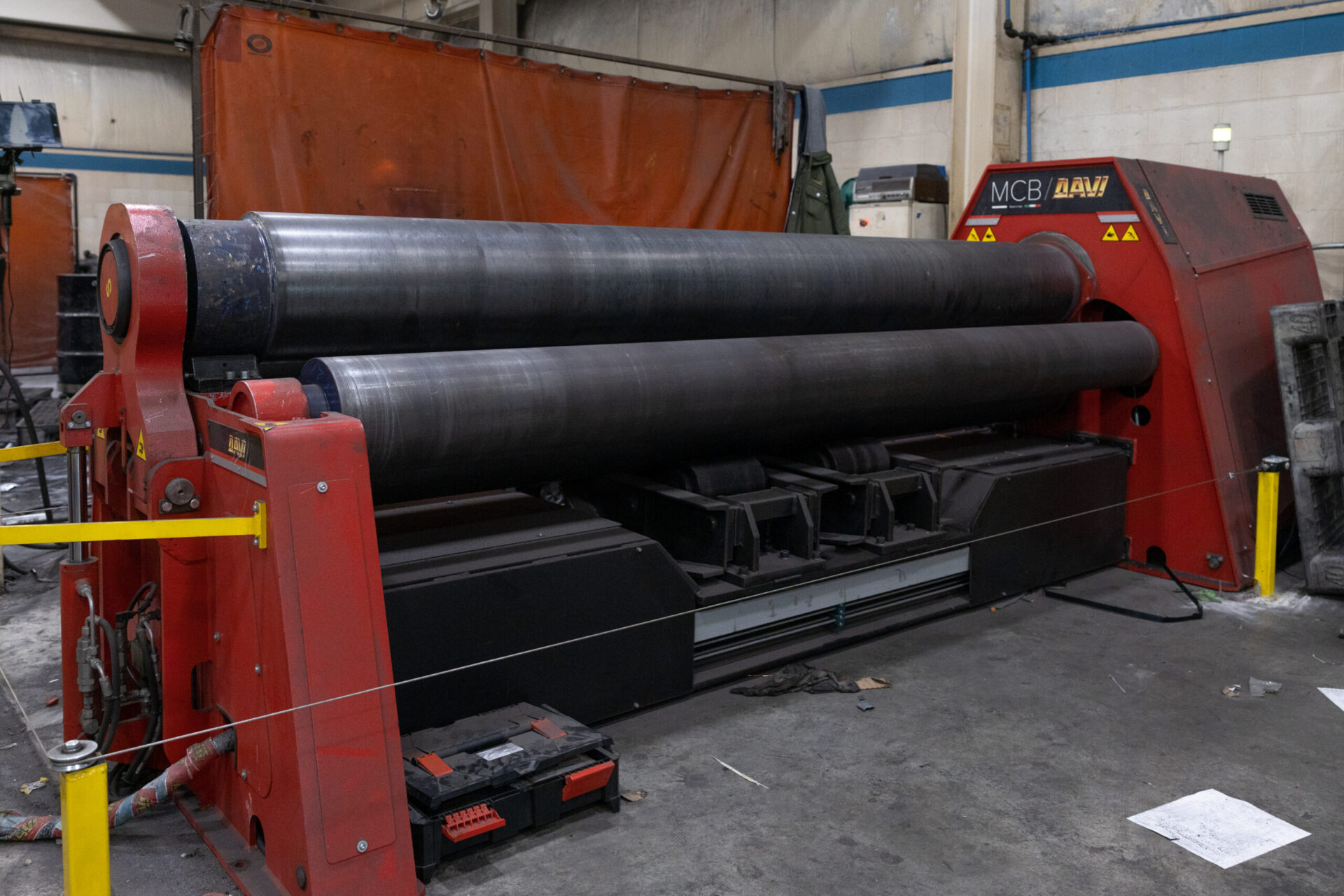
How the Rollers Work
A plate rolling machine uses two or more rollers positioned in a pyramid or pinch configuration. The plate passes between the rollers, which apply enough force to exceed the material’s yield strength, causing permanent plastic deformation. By adjusting roller position and making multiple passes, the operator shapes the plate to the required radius without fracturing the metal.
Most industrial plate rolls are either three-roll or four-roll machines. A three-roll (pyramid) roll uses one top roller and two bottom rollers. The plate feeds through, and the top roller presses down to create the bend. The operator repositions the plate and makes additional passes to develop a consistent radius across the full length. The flat sections at the leading and trailing edges, called flats, require special attention because the very end of the plate doesn’t see the same forming force as the middle.
A four-roll machine adds a fourth roller that acts as a pinch, holding the plate firmly as it feeds through. This design pre-bends both ends of the plate in a single setup, eliminating or significantly reducing the flat sections. Four-roll machines are faster on production work and typically deliver a tighter, more consistent cylinder. For critical applications where weld seam alignment and roundness tolerance matter, the four-roll configuration gives the operator more control over the final geometry.
Pre-bending is the step that handles those leading and trailing edges. Before the plate completes a full cylinder, the operator sets a specific roller offset and passes each end through to bend it to the required radius. Without proper pre-bending, you’d end up with straight tangent sections that create a flat spot in your finished cylinder. On heavy plate, getting the pre-bend right takes experience, because the material’s springback changes with thickness and grade.
What Plate Rolling Produces
Plate rolling produces cylinders, cones, arcs, and curved structural sections. Cylinders are the most common output, used in tanks and vessels. Cones require offsetting the roller angle. Arcs and curved sections appear in structural and architectural work. The same machine can produce all of these shapes with the right setup and operator skill.
Full cylinders are the most straightforward rolled form. The plate is formed to a radius where the two ends meet, then the seam is welded closed to create a pipe, tube, or vessel shell. The weld seam is then typically ground flush or tested depending on the application’s pressure or quality requirements.
Cones involve rolling the plate with the rollers set at an angle rather than parallel. The taper of the cone is controlled by that angle, and the operator must track the cone’s geometry carefully to avoid wrinkling on the inside radius or tearing on the outside. Cones are common in hoppers, funnels, transition pieces between different diameter vessels, and certain structural applications.
Curved arcs and sections, rather than full cylinders, are used in architectural metalwork, equipment housings, and curved structural members. Rolling a partial arc is common in bridge fabrication, agricultural equipment bodies, and custom machine guards. The plate is simply formed to a specific radius and removed before the ends meet.
Materials and Thickness
Plate rolling works on mild steel, stainless steel, aluminum, and most structural alloys. The practical thickness range depends on the machine’s capacity, measured in tons of rolling force. Light-gauge rolls handle thin sheet, while heavy-duty rolls can form plate that’s several inches thick. The minimum achievable radius scales with material thickness and yield strength.
Mild and low-carbon steel is the most common material rolled. It has predictable springback and responds consistently to force adjustments, which makes it easier to hit a target radius. Structural grades like A36 and A572 are both regularly rolled for vessels, columns, and frames. Higher-yield steels require more force and produce more springback, meaning the operator must overbend to account for the metal’s tendency to spring back after the force is released.
Stainless steel, particularly 304 and 316, can be plate-rolled but work-hardens faster than mild steel. This means the material gets stiffer as you form it, requiring more force partway through than at the start. Aluminum rolls easily and requires less force than steel for the same thickness, but it’s also more sensitive to surface damage from the rollers, so proper tooling and clean rollers are important.
Springback is a factor in every material. When the rollers release the plate, the metal recovers slightly from the bend. An experienced operator accounts for this by setting the rollers to produce a radius tighter than the target, then letting springback bring the part to the correct dimension. Getting this right on the first pass, especially on thick plate, comes from knowing how each material behaves under your specific machine’s force profile.
Applications and Industries
Plate rolling serves the energy, oil and gas, shipbuilding, structural steel, agricultural equipment, and pressure vessel industries. Any application that needs a large-diameter curved or cylindrical form from flat plate is a candidate for rolling. It’s significantly more practical than attempting to achieve the same geometry through machining or casting at industrial scale.
| Industry | Typical Rolled Parts | Key Requirement |
|---|---|---|
| Energy / Oil & Gas | Pressure vessel shells, storage tanks, separator bodies | Tight roundness tolerance, weld-seam alignment |
| Shipbuilding | Hull sections, pipe spools, structural frames | Large plate width, heavy thickness capacity |
| Structural Steel | Columns, curved beams, ring flanges, caissons | Consistent radius across full length |
| Agriculture / Material Handling | Grain bins, conveyor housings, hopper cones, chutes | Volume production, standard carbon or stainless |
| Mining / Construction | Pipe sections, equipment housings, wear liners | Heavy plate, abrasion-resistant grades |
| Architectural / Custom | Curved facades, columns, decorative structural elements | Aesthetic finish, tight radius on thinner plate |
In the energy sector, plate rolling produces the cylindrical shells that pressure vessels and storage tanks are built from. The rolled shell sections are then end-capped, fitted with nozzles, and welded to meet ASME or API specifications. Getting the roundness and weld seam alignment correct at this stage is critical because pressure rating calculations assume a true cylinder.
In agriculture and material handling, rolling is how you get large-diameter bins, hoppers, and conveyor drums. These parts see less precision pressure than an energy vessel, but they need to be consistent across a production run. A fabricator running ten identical hopper cones needs repeatable setups, not just one accurate part.
Rolling at Paragon
Paragon Metal Fabricators’ rolling capability handles a range of plate thicknesses and widths for both one-off and production work. Our operators have the experience to pre-bend, form, and close cylinders and cones accurately. Combined with our in-house welding, laser cutting, and forming capabilities, we can take a rolled part all the way from flat plate to finished assembly.
When rolling is just one step in a larger fabrication, having it in-house matters. A rolled cylinder shell that needs welded flanges, nozzle penetrations, or a powder coat finish doesn’t need to travel to multiple shops. We cut the flat blanks, roll the shells, weld the seams and fittings, and finish the assembly right here in Hebron.
For customers who need curved structural sections or custom vessel components, our team can work from your drawings or from a description of the required geometry. We’ll confirm the radius, thickness, and material before the first pass so you get the form you need without iterating through scrap parts. For complex rolled geometries, we’d recommend including as much dimensional detail as possible in your RFQ.
See our metal rolling service page for more on our capacity, or review our full fabrication services to understand how rolling fits into a complete fabrication workflow. If you’re sourcing formed plate alongside bends, our page on press brake forming explains how we handle angular bends on the same job.
Curved Parts, Built Right Here
Paragon Metal Fabricators has served the tri-state region for 40+ years from our Hebron, KY facility. Family-owned and full-capability, we roll, weld, and finish complex curved parts without farming work out. Get your quote today.
Frequently Asked Questions
What can plate rolling make?
Plate rolling produces cylinders, cones, arcs, and curved structural sections from flat metal plate. Common outputs include pressure vessel shells, storage tanks, pipe sections, grain bins, hopper cones, curved structural columns, equipment housings, and architectural curved forms. The same machine handles all of these shapes with different roller setups and operator adjustments.
How thick can you roll?
The maximum rollable thickness depends on the machine’s rated capacity, measured in tons of rolling force, and the plate’s width and yield strength. Industrial rolls routinely form plate from light sheet gauge up through several inches of steel. Very heavy plate, such as pressure vessel shell stock, requires a high-capacity four-roll machine. Contact us with your thickness, width, material, and target radius and we’ll confirm whether it falls within our equipment’s range.
Can you roll cones, not just cylinders?
Yes. Cones are produced by setting the rollers at an angle rather than parallel to each other, which creates a tapered form instead of a constant-radius cylinder. The cone’s included angle is controlled by the degree of offset between the roller axes. Cones are common in hoppers, funnels, transition pieces, and certain pressure vessel heads. The geometry must be calculated before rolling to ensure the flat blank develops into the correct cone dimensions after forming.
or call 1-800-467-0121