
Sheet Metal Forming / Northern Kentucky & Greater Cincinnati
What Is Press Brake Forming? Sheet Metal Bending Explained
Press brake forming is a sheet metal bending process where a punch presses material into a V-shaped die, creating precise, repeatable bends. The punch, die width, and ram force together control bend angle, bend radius, and material springback. It’s the standard method for brackets, enclosures, flanges, channels, and chassis parts.
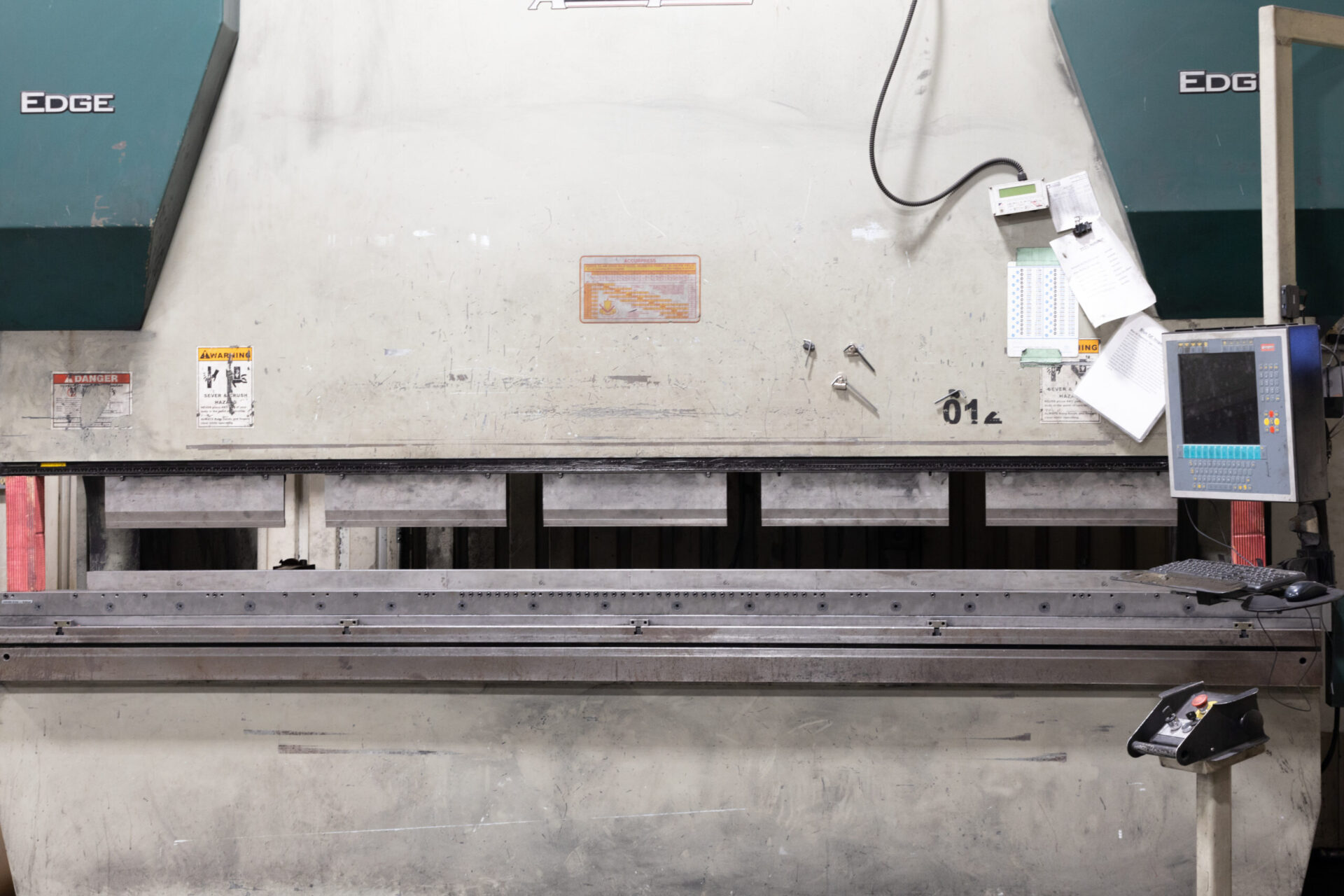
What Is Press Brake Forming?
Press brake forming is a sheet metal fabrication process that uses a hydraulic or mechanical press to drive a punch into a V-die, bending flat sheet or plate to a precise angle. It’s one of the most common metal forming operations and works across mild steel, stainless steel, aluminum, and most structural alloys.
The “press brake” itself is the machine: a long-bed press with a stationary bottom die (the die) and a moving top tool (the punch). When the ram descends, it forces the sheet metal to conform to the die’s angle. The resulting bend shape, sharpness, and angle all depend on the tooling geometry, the ram force (tonnage), and how far the punch travels into the die.
Press brakes are used for parts that need accurate, repeatable angular features. Think of brackets that mount to structural frames, enclosures that house electrical components, or flanged channels that run along machinery. If a flat sheet needs to become a three-dimensional shape with defined angles, press brake forming is almost certainly part of the process.
At Paragon, our press brake forming operation handles a wide range of material thicknesses and part sizes, from small precision brackets to large structural sections. Our operators program the ram stroke and backgauge position to hold tight angles across the full run of a part batch.
How It Works: Punch, Die, and Ram
The operator positions sheet metal over the V-die, then the ram drives the punch downward to a programmed depth. The sheet bends as the punch contacts and forces material into the die opening. Ram depth, die width, and punch radius together determine the final bend angle, inside radius, and part geometry.
The V-die opening width matters more than most people realize. A wider die opening requires less tonnage to form the bend but produces a larger inside radius and slightly more springback. A narrower opening demands higher force and produces a tighter radius. The correct die selection depends on material type, thickness, and the radius your design calls out.
The backgauge is the part of the machine that positions the sheet correctly before each bend. It’s a CNC-controlled stop that the operator programs to place every bend line at the exact intended location relative to the part edge. On a multi-bend part, the backgauge repositions between each step so every bend hits its marked line within tight tolerance.
Tonnage requirements scale with material thickness and tensile strength. A 10-gauge mild steel sheet takes more force to form than a 16-gauge piece of the same width. The press brake’s rated tonnage determines what thickness and length of material it can safely handle in a single pass.
The Three Bend Parameters That Drive Part Geometry
Every press brake bend involves three interdependent parameters: bend angle (the target angle between faces), bend radius (the inside curve at the bend line), and bend allowance (the flat length of material consumed by the bend). All three depend on material type, material thickness, and the die width selected for the operation.
Bend angle is measured between the two flat faces of the formed part. A 90-degree bend is the most common, but press brakes can produce acute angles (less than 90 degrees) and obtuse angles (greater than 90 degrees). Springback means the metal partially recovers toward flat after the punch retracts, so the punch typically overbends slightly to compensate and hit the specified angle in the finished part.
Bend radius is the inside radius of curvature at the bend line. A sharp punch and narrow die produce a small radius; a wider die produces a larger radius. Designers should specify the minimum inside bend radius at or above the material thickness to avoid cracking along the outside face of the bend. Tighter radii than this risk micro-fractures in the material’s outer fiber.
Bend allowance is the amount of flat material that gets consumed as it wraps around the punch radius. When you’re calculating the flat blank size for a part with multiple bends, you subtract the bend allowances from your total developed length to get the correct cut-to-length measurement. Every bend angle, radius, and material combination has its own bend allowance value, which is why accurate flat-blank programming requires engineering data rather than guesswork.
Bending Methods: Air Bending, Bottoming, and Coining
Three main methods exist. Air bending uses less tonnage and allows flexible angle control by varying ram depth, but can have more springback. Bottoming fully seats the punch into the die for accurate, consistent bends with less springback. Coining applies high force to permanently set the material, giving the tightest tolerances with essentially no springback.
Air bending is the most common method in production shops. The punch drives the material partway into the die without touching the die walls. Angle control comes from how far the punch travels: a deeper stroke produces a sharper angle. Because the metal doesn’t contact the die walls, the same die set can produce a range of angles just by reprogramming the ram depth. This flexibility makes air bending fast and economical for jobs with varied angle requirements. The tradeoff is that springback requires careful compensation, especially in materials with high yield strength like stainless steel.
Bottoming (also called bottom bending or partial coining) drives the punch until the material makes full contact with the die walls on both sides of the V. The die geometry then controls the final angle directly. Because the material bottoms out against the die, springback is significantly reduced compared to air bending, and angle consistency across a long production run is tighter. It requires higher tonnage than air bending for the same material and thickness.
Coining applies enough tonnage to actually compress the grain structure of the material at the bend line, cold-working it into permanent set. The result is a bend with almost zero springback and very tight angular tolerance. Coining is reserved for precision parts where angle accuracy is critical and where the higher tooling and press tonnage costs are justified by the application.
Materials and Parts It Makes
Press brake forming works across mild steel, stainless steel, aluminum, and a range of structural alloys. Common parts include brackets, enclosures, flanges, channels, and chassis sections. The process scales from thin-gauge precision parts to heavy plate bending, with material selection driven by strength requirements, corrosion resistance, and finish needs.
Mild steel is the workhorse. It forms easily, holds its angle well after bottoming or coining, and accepts welding and powder coating without issue. Most structural brackets, equipment frames, and general-purpose enclosures come from mild steel formed on a press brake.
Stainless steel (304 and 316 most commonly) has higher tensile strength and more springback than mild steel, so the operator must compensate with a larger overbend. Stainless is the choice when the finished part will be exposed to moisture, chemicals, or food-grade environments. It’s also used in architectural and aesthetic applications where surface appearance matters.
Aluminum is significantly lighter and forms with lower tonnage, but it’s more prone to cracking at tight bend radii than steel. Minimum inside bend radius requirements for aluminum are typically greater than for mild steel of the same thickness. Common applications include aerospace brackets, electrical enclosures, and lightweight structural components.
- Brackets and gussets Structural support pieces for machinery, frames, and equipment mounts.
- Enclosures and panels Electrical boxes, machine guards, and equipment housings formed from sheet stock.
- Flanges and channels Edge flanges for stiffening sheet panels; U-channels and C-channels for structural rails.
- Chassis and frames Base plates, sub-frames, and welded assemblies that start as flat blanks and end as complex 3D structures.
- Agricultural and industrial parts Heavy-gauge components for farm equipment, material handling, and construction applications.
Our full fabrication services mean that press brake formed parts often feed directly into welding and powder coating operations here under one roof, cutting your handling time and landed cost compared to sourcing those steps separately.
Design Tips for Press Brake Parts
Good design for press brake forming keeps inside bend radius at or above material thickness, places holes at least twice the material thickness away from bend lines, adds bend reliefs at notch corners, and standardizes bend radii across a part wherever possible. These choices cut scrap, reduce setup time, and lower your per-part cost.
Inside bend radius rule. The inside bend radius should be at or greater than the material thickness. Going tighter puts the outside fiber of the material under tensile stress that can cause cracking, especially in aluminum and in harder steel grades. If your design needs a very tight radius, flag it in your RFQ so we can evaluate the material, grain direction, and tooling before committing to it.
Hole placement near bends. Holes that land too close to a bend line will distort as the material deforms during forming. The standard rule is to keep hole edges at least twice the material thickness away from the bend line. Slotted holes are more forgiving than round holes near bends, but the safest approach is to put all holes outside the distortion zone.
Bend reliefs. When a bend terminates at a notch or a step in the part outline, adding a small relief cut at the corner prevents tearing and cracking along that corner during forming. The relief should extend at least 1.5 times the material thickness past the bend line.
Consistent radii. If you can standardize all your bends to the same inside radius on a single part, you reduce tooling changes and setup time during the run. Each different radius may require a different die, which adds cost on lower-volume jobs. Consistent geometry also simplifies flat-blank programming and speeds up first-article inspection.
For a deeper look at how design choices affect fabrication cost and quality, see our guide on design for laser cutting and sheet metal DFM. Many of the same principles carry across from laser cutting into forming operations.
If you’re also evaluating rolled curves rather than angular bends, our page on what is plate rolling covers the process for cylinders, cones, and large-radius arcs.
Ready to Form Your Next Part?
Paragon Metal Fabricators has 40+ years of press brake forming experience serving manufacturers across Northern Kentucky, Greater Cincinnati, and the tri-state region. We handle mild steel, stainless, aluminum, and structural alloys, from short prototype runs to high-volume production, all under one roof.
Frequently Asked Questions
What is air bending vs bottoming?
Air bending drives the punch partway into the die, with angle controlled by ram depth and without contact with the die walls. It requires less tonnage and allows flexible angle adjustment. Bottoming seats the material against the die walls for tighter angle consistency and less springback, but requires more tonnage than air bending for the same material.
What is springback in press brake forming?
Springback is the partial elastic recovery of sheet metal after the punch retracts. When the bending force is released, the material springs back toward flat by a few degrees. Operators compensate by overbending to a slightly sharper angle than the target. Springback is greater in high-strength materials like stainless steel and harder aluminum alloys than in mild steel.
What’s the minimum bend radius for sheet metal?
The minimum inside bend radius is typically equal to the material thickness. Going tighter risks cracking along the outside face of the bend, particularly in aluminum and higher-strength steel grades. The exact minimum depends on the specific alloy and temper. When in doubt, specify the radius in your drawing and ask your fabricator to confirm suitability before running parts.
or call 1-800-467-0121