
Industry Application / Packaging Equipment
Metal Fabrication for Packaging Equipment: Specs That Matter for High-Cycle Parts
Packaging equipment runs at high cycle counts, often 24 hours a day. Fabricated components need tight dimensional tolerances for proper machine fit-up, repeatable weld quality for dynamic load joints, and material choices matched to the product contact and cleaning requirements of the application. Stainless steel is standard for food and pharmaceutical contact; mild steel with powder coat handles structural frames and non-contact components.
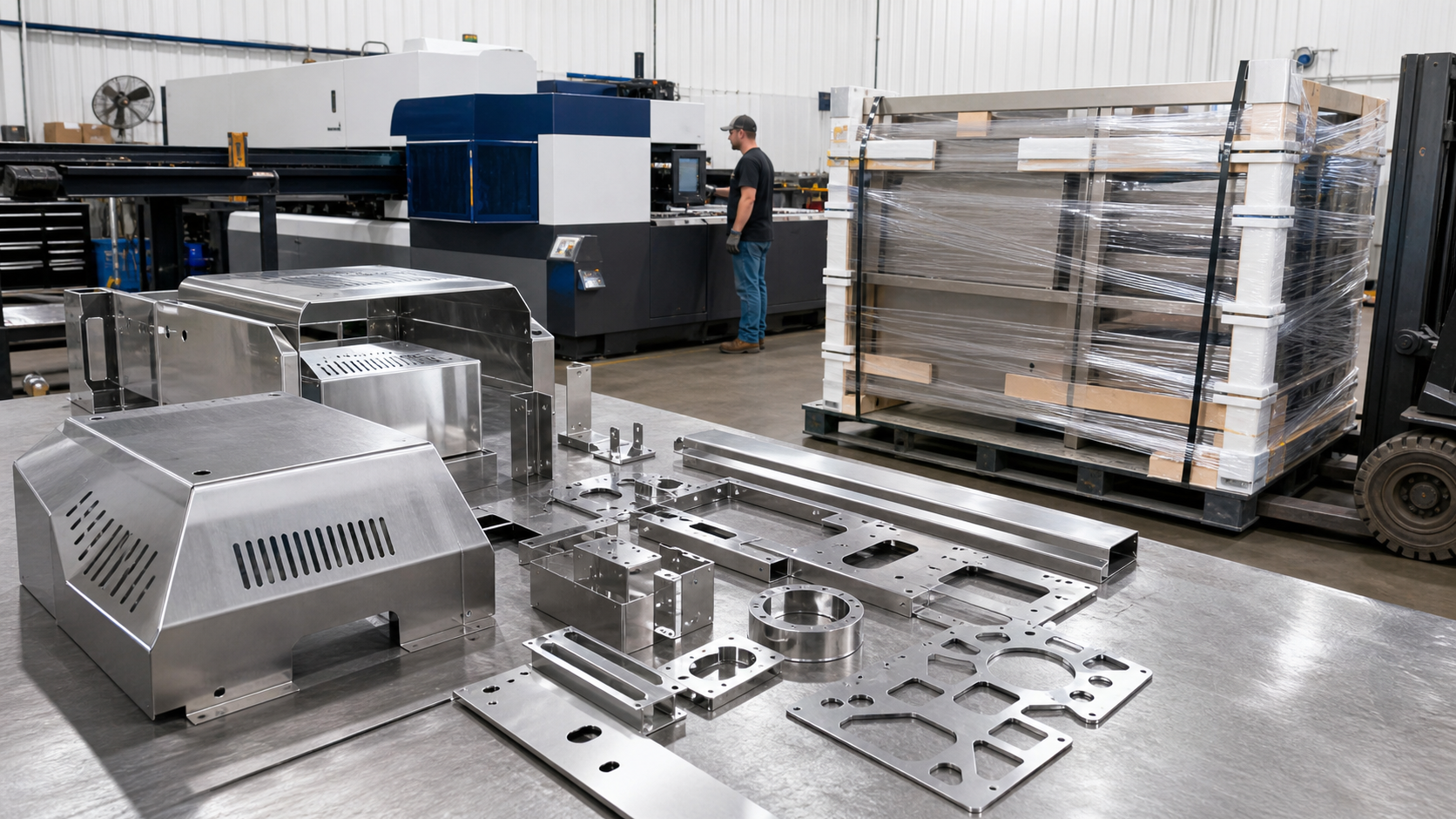
What Packaging Equipment Demands from Fabricated Parts
Packaging machinery runs continuously at high cycle rates, putting constant vibration, fatigue load, and wear on fabricated components. The primary requirements are dimensional accuracy for proper component fit-up and timing, repeatable weld quality that holds under dynamic load, and material choices that match the sanitation and corrosion requirements of the specific application. Tolerances tighter than typical structural fabrication are common on packaging machine components.
Packaging machine OEMs specify fabricated components across a wide range: machine frames and bases, product transport decks and guide rails, filling and dosing system housings, reject chutes and diverter gates, safety guards and enclosures, and cam-follower frames and mounting structures. These components live inside machines that run 24 hours a day and cycle hundreds of times per minute in high-production food and consumer product plants.
The reliability demand is real. A fabricated bracket that fails at 2:00 AM on a production line stops the line. A guide rail that’s 0.020 inches out of position causes jams and rejects at high speed. Packaging machine OEMs cannot afford the kind of tolerance variability that’s acceptable in structural steel work. They need fabricated parts that arrive ready to install and stay within spec across the production run.
Paragon has served packaging equipment OEMs and custom machine builders in the tri-state region for decades. We understand what it means to fabricate precision components for high-cycle machinery, and we build quality into the process rather than inspecting it in at the end.
Common Fabricated Parts in Packaging Machinery
Common fabricated components in packaging equipment include machine frames and weldments, product conveying and guide rail systems, filling heads and dosing unit housings, chute and transfer guide assemblies, machine guards and safety enclosures, cam-follower bases, and equipment stands and bases. Stainless steel and mild steel are the dominant materials depending on whether the component is food-contact or structural.
Machine frames are typically the largest fabricated component in any packaging machine. They’re structural weldments that carry all other components and must be flat, square, and torsionally rigid. Distortion from welding is the main risk: a frame that racks even slightly during weld cooling will cause alignment issues with the components mounted to it. Fixturing and weld sequence control are how fabricators keep frames within spec.
Product guide rails and conveying surfaces are often stainless steel: smooth surfaces for easy cleaning, corrosion resistance for wash-down environments, and no risk of contamination from rust or coating flake. Guide rails in food-contact applications sometimes have specific surface finish requirements expressed in Ra (average roughness) values. Our team can fabricate to these specifications and discuss finish options if your application has specific requirements.
Guard and safety enclosure fabrication for packaging equipment usually means laser-cut sheet with formed edges, accurate hole patterns for access panels and sight windows, and clean weld seams. Guards need to be dimensionally accurate enough to mount correctly on the machine frame without rework. They also need enough structural rigidity to stay in place without vibration-induced rattling during operation.
Equipment bases and stands are structural weldments that raise the machine to the right working height and provide a rigid foundation. Leveling pads, drain holes for wash-down, and anchor bolt patterns are common features. These are typically mild steel with powder coating for general food industry environments that don’t involve direct product contact.
Material Selection: Stainless vs Mild Steel
Food-contact and wash-down surfaces use 304 stainless steel as the standard material. It resists the cleaning chemicals and sanitizers used in food plants, won’t corrode or contaminate product, and can be finished to hygienic surface roughness specifications. Structural frames, bases, and non-contact guards use mild steel with powder coating, which costs less and fabricates faster while providing adequate corrosion resistance for the non-contact environment.
304 stainless is the default for food and pharmaceutical packaging because it holds up to CIP (clean-in-place) cycles, alkaline and acidic sanitizers, and the steam cleaning used in some production environments. Its corrosion resistance comes from a passive chromium oxide layer, and that layer needs to be protected during fabrication: stainless tooling, no carbon steel contact, and clean handling to prevent iron contamination that would cause rust spots in service.
316 stainless is specified in more aggressive chemical environments, particularly when chloride-containing sanitizers are used at high concentration or elevated temperature. 316 has higher molybdenum content which improves resistance to pitting corrosion from chloride. It costs more than 304 and isn’t necessary in most food packaging applications, but it’s the right call in specific situations. Our team can advise if you’re unsure which grade fits your application environment.
For non-contact structural components, mild steel with a powder coat finish is the economical and practical choice. A properly prepared and coated steel frame holds up for years in the ambient environment around a packaging machine. The key is quality surface prep (clean metal, correct blast profile) and a powder system matched to the environment (standard indoor, or primer-plus-topcoat for wet or aggressive cleaning zones).
For a broader look at material selection across fabrication applications, see our comparison of galvanized vs. stainless vs. mild steel.
Tolerances and Repeatability for High-Cycle Parts
Packaging machine components typically require tighter tolerances than general structural fabrication. Hole location tolerances of plus or minus 0.005 to 0.010 inches are common on mounting holes for drive components. Overall frame dimensions may run plus or minus 0.015 to 0.030 inches. These tighter requirements are achievable on our fiber laser and press brake equipment, and first-article inspection is standard on new part setups for packaging OEM programs.
The distinction between structural tolerances and machine-component tolerances matters to the fabrication shop because it drives the inspection protocol and sometimes the process choices. A structural frame bracket can usually be produced without first-article inspection because the tolerance requirements are well within the natural capability of the laser and press brake. A precision mounting bracket for a drive assembly benefits from first-article inspection before releasing the production run.
Our fiber laser produces hole locations within plus or minus 0.005 inches on steel at typical packaging equipment gauges (3/16 to 1/2 inch). That’s tighter than most structural fabrication needs, which is why it’s a good fit for packaging machine components. Press brake bends hold plus or minus one to two degrees on angle and plus or minus 0.015 to 0.030 inches on flat-to-flat dimensions, which is consistent with packaging machine requirements at most gauges.
For a full overview of what tolerance ranges to expect from each fabrication process, see our guide on sheet metal fabrication tolerances.
Surface Finish for Packaging Applications
Stainless steel components in food contact or wash-down areas are typically left with a mechanical finish: #4 brushed (the most common hygienic finish, with a smooth directional grain), electropolished for maximum corrosion resistance and minimal surface roughness, or ground to a specific Ra value. Mild steel structural components receive powder coating matched to the cleaning and environmental requirements of the installation.
The #4 brushed finish on stainless is the default for food and pharmaceutical packaging because it’s easy to clean, visually shows contamination, and meets most FDA and USDA sanitary design guidelines for surface roughness. The finish is applied by running abrasive belt or wheel across the surface in one direction to produce a consistent linear grain. Weld areas need to be blended smooth and refinished to match the surrounding surface.
Electropolishing is used when extra corrosion resistance or an extremely smooth surface is required. The process removes material from the surface by electrolytic dissolution, leaving a bright, smooth, microscopically passivated surface. Ra values below 0.8 micrometers (32 microinches) are achievable. This is beyond what most standard packaging applications require but shows up in pharmaceutical and biotech processing equipment where strict surface roughness standards apply.
Powder coating on mild steel structural components for packaging equipment benefits from the same primer-plus-topcoat approach used in food plant equipment: a primer for corrosion protection at cut edges and welds, and a topcoat selected for washability and resistance to the cleaning chemicals used in the facility. White and light gray are common colors in food plants for visibility and cleanliness.
Precision Parts for Your Packaging Line
Paragon Metal Fabricators builds precision fabricated components for packaging machine OEMs in Northern Kentucky and Greater Cincinnati. Our full capability under one roof means your parts move from laser cutting through welding and coating on a single timeline.
Frequently Asked Questions
Can you fabricate stainless steel packaging equipment components?
Yes. We fabricate 304 and 316 stainless steel components for packaging and food processing equipment. Our shop uses dedicated stainless tooling and clean handling procedures to prevent carbon steel contamination that would compromise corrosion resistance. We can produce laser-cut, formed, and welded stainless assemblies to your drawings and can discuss surface finish requirements for your specific application.
What tolerances are typical for packaging machine parts?
Packaging machine components typically require tighter tolerances than general structural work. Hole location tolerances of plus or minus 0.005 to 0.010 inches are common on mounting holes for drive components. Frame dimensions often run plus or minus 0.015 to 0.030 inches. Our fiber laser and press brake equipment handles these requirements on standard packaging machine gauges. First-article inspection is standard for new part setups on OEM programs.
Do you handle small-run packaging equipment prototypes?
Yes. Prototype and low-volume production runs are a regular part of our business. Packaging machine OEMs frequently need prototype components during machine development before committing to production tooling and volumes. We work from your drawings and can accommodate small runs with the same quality standards we apply to full production. Contact us with your drawings and we’ll give you a timeline and quote.
What is the standard surface finish for stainless food contact surfaces?
Number 4 brushed finish is the most common surface finish for stainless steel food contact and wash-down surfaces. It meets FDA and USDA sanitary design guidelines for surface roughness and is easy to clean and inspect. For applications with stricter surface roughness requirements, electropolishing achieves Ra values below 0.8 micrometers. We can discuss specific finish requirements for your application when you submit drawings.
or call 1-800-467-0121