
Industry Applications / Energy and Industrial
Metal Fabrication for Energy and Industrial Equipment: What OEMs Need to Know
Energy and industrial equipment OEMs need a fabrication shop with structural capability across the full process chain: plate rolling for cylindrical and conical components, heavy welding for structural frames and pressure-bearing assemblies, precision laser cutting for repeated components, and surface finishing for corrosion resistance. Material traceability, weld procedure qualification, and dimensional control on large assemblies are the supply chain requirements that separate capable fabricators from general shops.
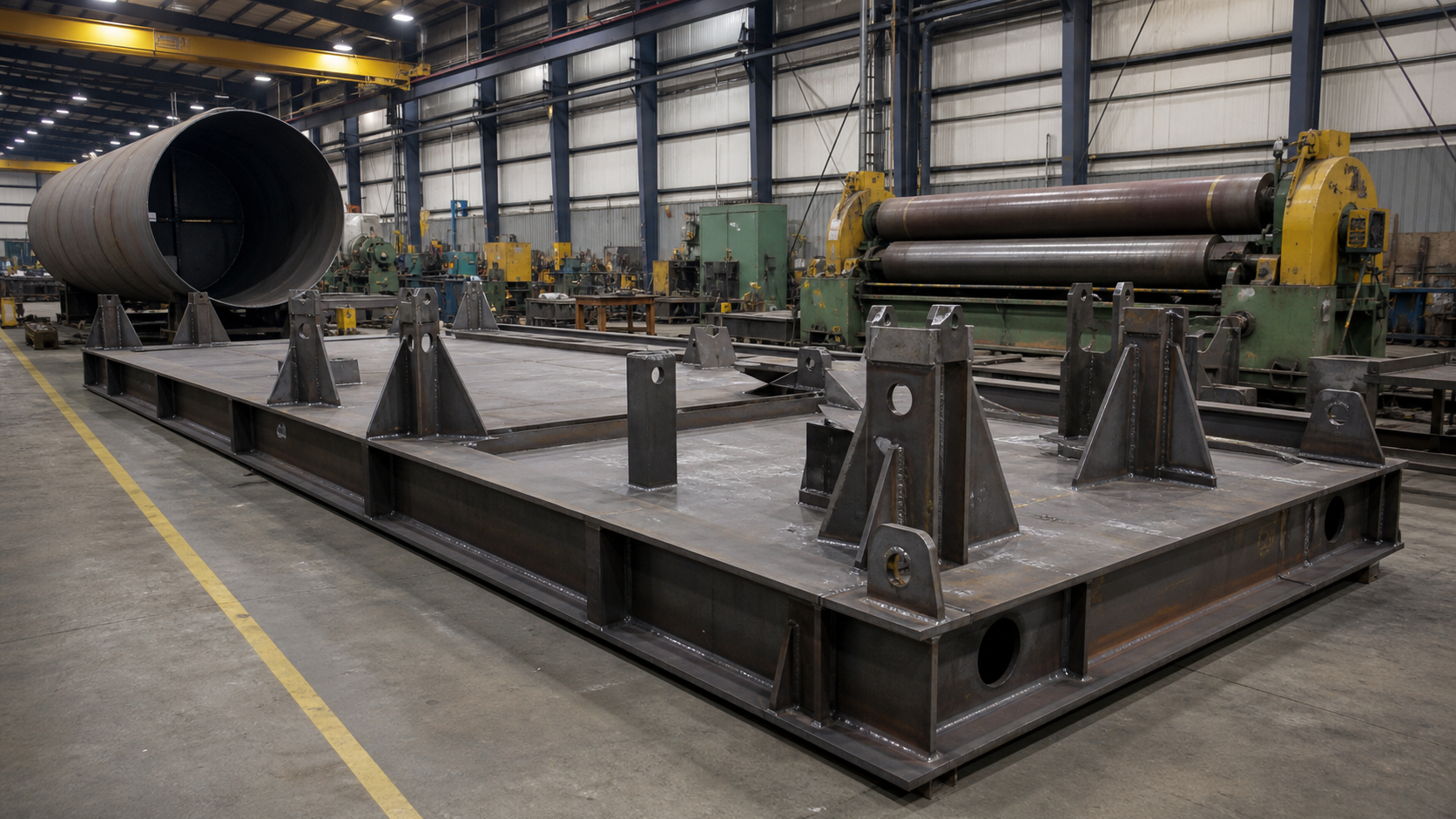
What Energy OEMs Need from a Fabrication Shop
Energy and industrial equipment OEMs have requirements that go beyond what a general fabrication shop can support. They need a shop with certified welding procedures, material traceability from mill cert to finished part, rolling and forming capability for non-flat geometry, and the capacity to handle large assemblies with close dimensional tolerances. They also need a shop that understands the schedule pressure of equipment builds and can respond when a design change or a supply chain issue forces a pivot.
The energy sector includes a wide range of equipment types: power generation skids, heat exchangers, pump housings, tank and vessel components, electrical enclosures for outdoor service, support structures for solar arrays and wind turbine ancillaries, and industrial conveyor frames and platforms. Each has its own material, tolerance, and inspection requirements, but they share a common need for a fabricator that can handle structural complexity at reasonable volume.
Supply chain consolidation is a priority for most OEM purchasing teams. A shop that can handle laser cutting, forming, rolling, welding, and powder coating under one roof reduces the number of vendor relationships to manage, the number of freight moves between operations, and the scheduling exposure that comes from coordinating multiple specialized shops on a single assembly. Paragon’s full-service capability is built specifically for that kind of consolidated supply relationship.
Geographic proximity matters for energy and industrial OEMs in the Greater Cincinnati and Northern Kentucky region. Short transport distances mean faster response to design changes, lower freight cost on heavy assemblies, and the ability to do an in-person review of a first article before production releases. For OEMs building equipment in the tri-state region, working with a local fabricator provides supply chain resilience that a distant shop cannot offer.
Common Parts: Frames, Housings, Pressure Components, and Brackets
The most common fabricated parts in energy and industrial equipment are structural frames and base skids, formed and rolled housings and enclosures, support brackets and gussets, tank shell sections and nozzle reinforcements, heat transfer component supports, and guard and access structures. These parts span a wide range of sizes, from small machined-and-welded brackets to structural frames that ship on flatbed.
Structural base frames and skids are a core fabricated product for energy equipment OEMs. A pump skid, a generator base, or a heat exchanger support frame is typically built from structural steel tube, wide flange, or plate, welded and drilled to a dimensional layout that must match the equipment mounting pattern. Fit-up tolerances on skids are tighter than general structural steel because the equipment being mounted has fixed hole patterns and leveling requirements.
Formed and rolled enclosures protect electrical and mechanical components in outdoor and industrial service environments. These range from simple NEMA-rated electrical boxes made from 12-gauge sheet to complex multi-panel enclosures with integral cable management and ventilation. Material selection for outdoor enclosures is typically 14 to 11-gauge steel, galvanized or powder coated for corrosion resistance, or stainless for chemical or coastal environments.
Tank and vessel shell sections are produced by plate rolling, where flat plate stock is formed into cylindrical or conical sections to precise inside diameter and roundness specifications. The rolled section is then welded at the longitudinal seam and fitted with nozzles, flanges, and head sections. This work requires a rolling machine with sufficient capacity for the plate thickness and width, and a welder qualified to the applicable pressure vessel or structural code.
Support brackets, gussets, and mounting plates are high-volume, repeating parts for most OEM programs. These are typically laser cut from plate and either delivered flat or formed to a specified angle before assembly. For OEM programs with consistent repeat orders, Paragon can maintain stock programs, blanket order arrangements, or kanban-style releases to match the customer’s assembly schedule.
Key Processes: Plate Rolling, Forming, Laser Cutting, and Welding
Energy and industrial fabrication draws on the full process toolkit. Plate rolling produces cylindrical and conical sections from flat stock. Press brake forming makes angles, channels, and enclosure panels. Laser cutting produces flat blanks, hole patterns, and cut-outs with repeatability suitable for production runs. Structural welding joins all of these components into finished assemblies. A shop with all four capabilities handles the complete manufacturing sequence without external handoffs.
Plate rolling is a process that many fabrication shops don’t offer because the required equipment is capital-intensive and the skill level to produce accurate cylinders from heavy plate is specialized. Rolling a cylinder to a specified inside diameter requires progressive passes through a three-roll or four-roll machine, with the operator adjusting roll position between passes to achieve the target curvature. The finished cylinder must meet roundness and diameter tolerances so the longitudinal weld seam fits tight and the mating heads or flanges go on square.
Paragon’s plate rolling service handles a range of plate thicknesses and cylinder diameters. For OEM programs requiring rolled cylinders or conical sections, contact our team with the target inside diameter, plate thickness, and material grade to confirm capacity and get a quote.
Laser cutting provides the precision hole patterns, cut-outs, and flat blank profiles that make up the majority of the component count in a complex assembly. Tight laser tolerances mean components arrive at the weld fixture at consistent dimensions, which reduces fit-up variation and welding time. For production programs with many similar parts, laser cutting reduces per-part cost through efficient nesting and fast cycle times.
Structural welding is where the upstream operations come together. Qualified welding procedures, experienced welders, and a shop floor organized for efficient assembly work all contribute to weld quality and throughput. For energy applications, weld quality documentation and process control are often part of the purchase order requirements, and the fabricator must be able to support those requirements through documented procedures and certified welders.
Material Requirements: A36, A572, Stainless, and Beyond
The most common structural grades for energy equipment fabrication are ASTM A36 (general structural plate, angles, flats) and ASTM A572 Grade 50 (higher yield strength structural plate). A572-50 is widely used for base frames and structural members where weight reduction or span efficiency matters. For corrosion-resistant applications, 304 and 316 stainless steel are the standard choices. Specialty grades including duplex stainless, low-temperature-rated grades, and pressure vessel-certified plate are available through certified material suppliers.
A36 and A572-50 are stock items at steel service centers and carry short lead times. Both weld well with standard procedures and filler metals, and both are readily available in plate, flat bar, angle, tube, and wide flange shapes. For most structural energy equipment applications that operate at ambient temperature and moderate pressure, these two grades cover the majority of material needs.
Stainless steel fabrication for energy applications is common in chemical processing, water treatment, and food-grade industrial equipment. 304 stainless is the general-purpose choice for mild corrosive environments. 316 stainless adds molybdenum for better resistance to chloride corrosion and is specified for chemical and marine applications. Duplex stainless (such as 2205) offers higher strength and better chloride resistance than standard austenitic grades and is used in demanding process environments where both strength and corrosion performance matter.
Material traceability is a requirement for many energy and industrial programs. Traceability means that each plate or bar can be traced back to a specific mill heat number and the corresponding mill test report (MTR). The MTR documents the chemical composition and mechanical properties of the material from the heat of steel it came from. OEMs specifying material traceability should communicate this requirement at the RFQ stage so the fabricator can confirm material sourcing and documentation practices before quoting.
For help comparing galvanized, stainless, and mild steel for your specific application, see our material comparison page.
Tolerances and Quality for Industrial Applications
Industrial and energy equipment fabrications typically call for tighter overall dimensional tolerances than general structural steel because the components must interface with equipment that has fixed mounting patterns or alignment requirements. Flatness tolerances on base skids, perpendicularity on frame members, hole location tolerances for equipment mounting, and overall squareness of large assemblies are the dimensions that most often matter for OEM fit and function.
Base skid flatness is a common specification for energy equipment. A pump or compressor mounted on a skid that isn’t flat will develop bearing and seal problems from misalignment. Typical skid flatness requirements run from 0.060 inches over the full length for general-purpose equipment to 0.015 inches for precision machinery mounts. Achieving tight flatness on large welded assemblies requires fixturing during welding, controlled weld sequence, and sometimes a final flattening pass on a press or surface grinder.
Hole location tolerances for equipment mounting must match the equipment manufacturer’s bolt pattern tolerances. A pump with a specified bolt pattern tolerance of plus or minus 0.010 inches requires the skid base plate holes to hold similar or better tolerances. Laser-drilled or punched holes on a CNC machine hold location tolerances comfortably within plus or minus 0.005 inches, which is sufficient for most equipment mounting applications.
For welded assemblies, overall squareness and perpendicularity are function checks, not just cosmetic ones. A frame that’s racked or out of square will interfere with equipment clearances, door and panel fits, and alignment to adjacent structures. First-article inspection on a new assembly should check diagonal measurements, level readings at key reference points, and perpendicularity of critical faces before the production run begins.
Fabrication for Energy at Paragon
Paragon has supplied fabricated components and assemblies to energy, industrial, and heavy equipment OEMs in the tri-state region for decades. Our shop runs laser cutting, tube laser, waterjet, plate rolling, press brake forming, CNC machining, structural welding, and in-house powder coating under one roof in Hebron, KY. For OEM buyers who need consistent quality, responsive communication, and a shop that can grow with a program, contact our team to discuss your requirements.
Energy and industrial programs often start with a design collaboration conversation rather than a formal RFQ. If you’re in early engineering on a new product line, bringing your fabricator into the conversation at the design stage allows them to flag manufacturability issues, recommend material alternatives, and size their capacity against your volume forecast before you’ve locked the design.
For programs already in production or nearing launch, the RFQ process is straightforward: provide current drawings with full GD&T callouts, material specifications, required certifications, quantity and schedule, and any special inspection or documentation requirements. Our team reviews RFQs thoroughly and provides a detailed quote with process notes so you know exactly how the parts will be made and what quality controls apply.
For agricultural and other industrial equipment applications similar to the energy sector, see our pages on metal fabrication for agriculture and metal fabrication for material handling for application-specific capability information. You can also review our full services overview or our welding service page for specifics on structural welding capability.
Energy and Industrial OEM Programs
From structural base frames to rolled shell sections, Paragon handles the full fabrication sequence in Northern Kentucky. Send us your drawings and we’ll build a quote around your program requirements.
Frequently Asked Questions
Do you work with A572 or other structural grades for energy applications?
Yes. ASTM A572 Grade 50 is one of our most commonly processed materials for structural equipment fabrication. We source it in plate, flat bar, angle, and wide flange shapes from regional service centers with short lead times. We also work with A36, 304 and 316 stainless, and specialty grades for specific applications. If your program requires a material grade not listed here, contact our team and we’ll confirm availability through our material supply chain.
What plate rolling capability does Paragon have?
Our rolling capability handles structural plate in a range of thicknesses and cylinder diameters suitable for most industrial equipment components. For specific capacity questions including maximum plate thickness, minimum and maximum cylinder diameter, and available material grades, contact our team directly at 1-800-467-0121 or through our contact page. Rolling is quoted job by job based on material, diameter, and tolerance requirements.
Can you handle large structural weldments?
Yes. Our shop floor accommodates large assemblies including base skids, structural frames, and multi-section weldments. Specific size limits depend on part geometry and the processes involved. For equipment with oversized dimensions, contact us with your part envelope and we’ll confirm floor capacity and fixturing approach. We regularly produce base frames and structural assemblies that ship on flatbed.
Do you provide material certifications and traceability?
Yes. We can provide mill test reports (MTRs) with fabricated parts when material traceability is specified. MTRs document the chemical composition and mechanical properties of the material from the originating heat of steel. To ensure traceability documentation is maintained through cutting and fabrication, specify the requirement on your drawing or in the purchase order at the time of quoting. This allows us to set up proper material control procedures before the job begins.
or call 1-800-467-0121