
Industry Application / Material Handling
Metal Fabrication for Material Handling Equipment: Parts, Processes, and Key Specs
Material handling equipment demands fabricated steel parts that hold up under continuous load, vibration, and impact in industrial environments. Conveyor frames, hopper bodies, chutes, guard rails, brackets, and structural supports are common fabricated components. The right fab shop brings laser cutting, forming, welding, and powder coating under one roof so MHE OEMs can source complete subassemblies rather than managing multiple vendors.
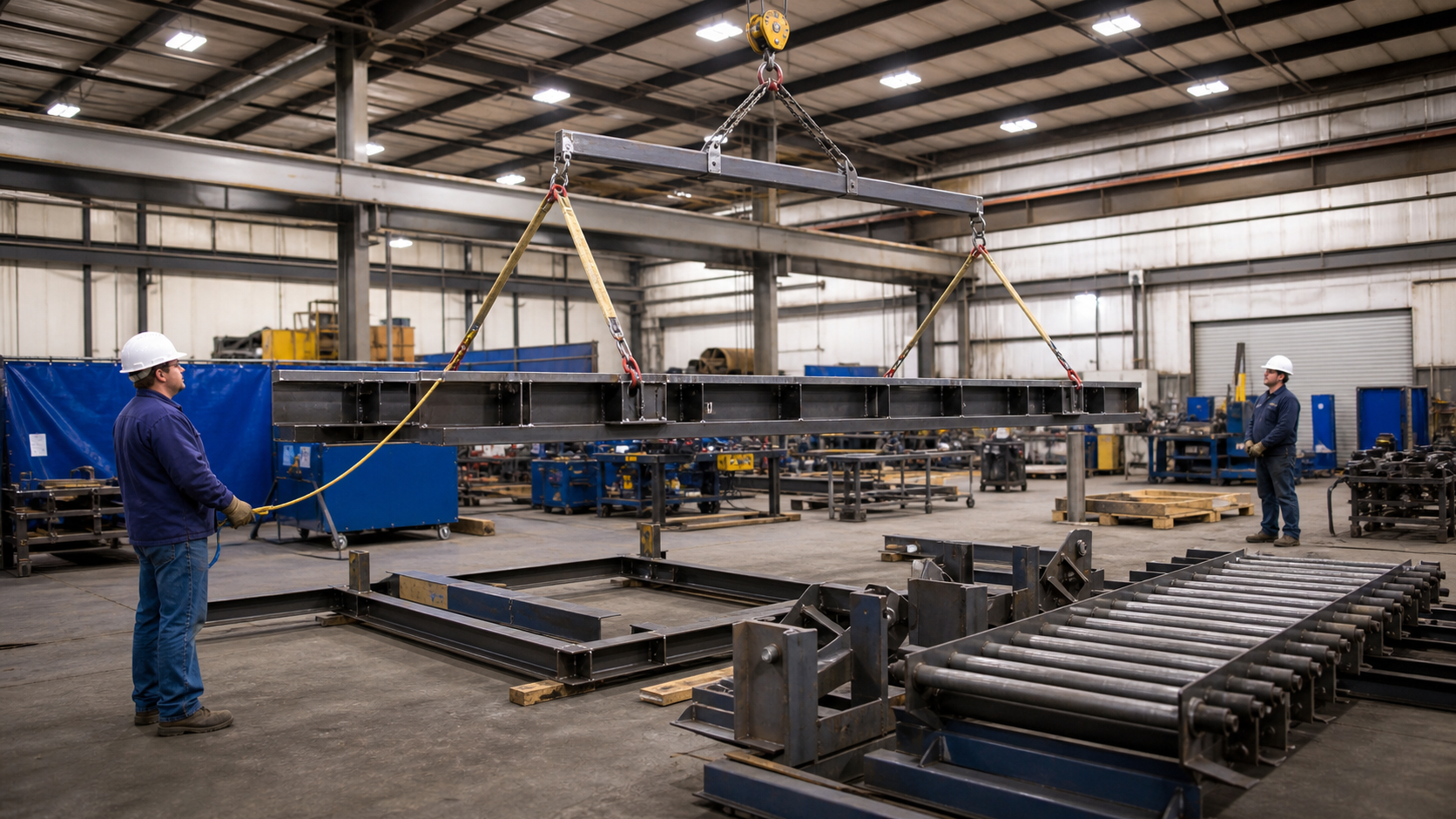
What Material Handling Equipment Needs from a Fab Shop
Material handling equipment operates in demanding environments: high cycle counts, constant load, vibration, impact, and often exposure to abrasive materials or harsh cleaning chemicals. Fabricated components for MHE need accurate dimensions for assembly fit-up, weld quality that holds under dynamic load, and a durable finish that resists corrosion and abrasion over a multi-year service life.
OEM engineers specifying fabricated subassemblies for material handling equipment care about a short list of things: parts that arrive to dimension and ready to assemble, weld quality that won’t fail in service, and a supplier that can handle repeat orders without quality drift as volume scales. None of that is complicated. What makes it difficult is finding a shop that delivers on all three consistently at production volumes.
At Paragon, we’ve built material handling components for tri-state OEMs and equipment assemblers for decades. The work ranges from simple laser-cut brackets and formed chute sections to complete welded frame subassemblies that go directly into your final assembly line. We work from your drawings, flag DFM issues before cutting starts, and keep quality consistent across the run.
Our full fabrication capability, from laser cutting through certified welding and powder coating, means your MHE parts move through a single production chain without vendor handoffs adding time or handling risk to your timeline.
Common Material Handling Parts We Fabricate
Common fabricated components for material handling equipment include conveyor side frames and cross-members, hopper bodies and chute sections, belt guard assemblies, pallet rack uprights and beams, drive and idler mounting brackets, equipment bases and skids, stair stringers, and safety guard panels. Most are structural steel weldments, laser-cut sheet, or a combination of both.
Conveyor framing is one of the highest-volume fabrication categories in the material handling space. Side frames are typically laser-cut or waterjet-cut structural steel with formed flanges, punched or drilled mounting holes, and welded cross-member connections. The key requirement is dimensional consistency run to run so that your roller and belt components go in without modification.
Hopper and chute sections see high abrasion from bulk material flow. Common approaches include using heavier-gauge mild steel (3/16 or 1/4 inch plate), adding wear liner attachment points, or in aggressive applications moving to AR (abrasion-resistant) plate. Welded seams on hoppers need to be continuous and ground flush to prevent material hang-up that disrupts flow and causes bridging issues.
Guard and safety panel fabrication covers OSHA-compliant machine guards, belt guard assemblies, pinch-point enclosures, and safety railings around elevated equipment. These typically start as laser-cut sheet with formed edges and welded frames, then get powder coated in safety yellow or another compliant color. Accurate hole patterns for fastener attachment are critical on guards that need to be removed for maintenance access.
Equipment bases and skids are structural weldments that need to be flat and square so the equipment mounted to them stays in alignment over time. Distortion control during welding is critical on long, heavy base frames. Our team sequences welds and uses fixture tooling to keep distortion within tolerance on large weldments.
Key Fabrication Processes for MHE Components
Material handling fabrication draws on laser cutting for accurate structural blanks and hole patterns, press brake forming for flanges and channels, structural welding for joints that hold under dynamic load, and powder coating for corrosion and abrasion resistance. Waterjet cutting handles thick plate or heat-sensitive materials where laser parameters limit throughput.
Laser cutting is the primary starting point for most MHE sheet and plate work. Our fiber laser handles mild steel up to 1 inch and produces accurate hole patterns that eliminate the drilling step on most bracket and guard designs. For tube and structural steel sections, our tube laser cutting service handles round pipe, square tube, rectangular tube, and angle iron with compound cuts and coped ends in a single pass.
Press brake forming produces flanges, channels, and mounting returns on sheet parts. Accurate bend angles and consistent bend radius are important on formed parts that mate with other components in the assembly. We hold bend angles to within one to two degrees and flat-to-flat dimensions to within 0.015 to 0.030 inches on standard sheet gauges.
Welding is where material handling fabrication quality shows up in service. MHE weldments carry dynamic loads: vibration from conveyor motion, impact from material drop points, and fatigue cycles from thousands of shifts of continuous operation. Our certified welders follow the WPS (welding procedure specification) for the joint type and material, and we visually inspect all structural welds before shipment.
Waterjet cutting is the right call for thick plate that exceeds fiber laser capacity, for heat-sensitive materials, or for parts with geometry that benefits from a cold cutting process with no heat-affected zone. Many MHE applications use plate in the 1/2 to 1.5-inch range where waterjet produces clean edges without the thermal effects that can affect weldability.
Material Selection for Material Handling Applications
A36 mild steel is the standard structural choice for most material handling frames, bases, and non-abrasive chute sections. It’s economical, welds cleanly, and takes powder coating well. For high-abrasion wear surfaces, AR400 or AR450 plate adds service life. Stainless steel (typically 304) is specified in food processing and pharmaceutical conveying applications where sanitary standards apply.
A36 is the workhorse of structural fabrication. It has enough yield strength for most structural applications in material handling, it’s available in the full range of plate and sheet sizes, and it costs significantly less than higher-grade alternatives. For most conveyor frames, brackets, guards, and equipment bases, A36 or its equivalent is the right call unless there’s a specific design requirement for higher strength or corrosion resistance.
ASTM A572 Grade 50 is a higher-strength structural steel that shows up in applications where A36 dimensions would be too heavy or where long spans require more stiffness at a given thickness. The extra cost over A36 is modest, and the material processes similarly. Some MHE designs specify A572 to reduce weight without changing cross-section dimensions.
AR plate (abrasion-resistant steel in grades like AR400 and AR450) is specified for liners in hoppers, chutes, and equipment in direct contact with bulk material flow. AR plate is considerably harder than structural steel and requires specific welding procedures to avoid cracking in the heat-affected zone. It’s not a drop-in swap for A36 on structural applications. Our team can advise on the right approach for your wear surface application.
For food processing and pharmaceutical conveying, 304 stainless is the standard. It resists the cleaning chemicals used in those environments, doesn’t contaminate product, and meets hygienic surface finish requirements with the right fabrication and polishing approach. Stainless fabrication requires separate tooling and handling procedures to prevent carbon steel contamination, which would compromise the corrosion resistance. Paragon handles stainless fabrication for industrial applications across the tri-state region.
Surface Finish: Powder Coat and Beyond
Powder coating is the standard finish for carbon steel material handling equipment: it adds corrosion resistance, abrasion resistance, and a clean professional appearance. Structural yellow is common for safety visibility. For high-abrasion wear surfaces that see direct contact with bulk material, powder coating alone isn’t durable enough and AR liner plate or UHMW plastic sheeting is the right solution instead.
Our in-house powder coating line applies a full range of color and texture options. Safety yellow and OSHA orange are high-volume for MHE guard and safety panel applications. Textured finishes (rather than gloss) hold up better in industrial environments where parts see regular handling, because texture hides minor abrasion marks that would show clearly on a gloss surface.
For equipment in wash-down environments, the powder coating specification should call for a primer coat under the topcoat to improve adhesion and corrosion resistance at cut edges and weld seams. A single-coat system on bare steel is adequate for most dry indoor applications; a primer plus topcoat system is worth the added cost in wet or corrosive environments.
Some MHE components, particularly wear liners and internal chute surfaces, are better served by bolt-on UHMW polyethylene liners than by any metal surface treatment. UHMW has an extremely low coefficient of friction against bulk materials, resists impact, and can be replaced without cutting or welding. The decision between AR plate and UHMW liner depends on the material being handled, the impact energy at the drop point, and the serviceability requirements of the installation.
Fabrication That Keeps Your MHE Line Moving
Paragon Metal Fabricators has served material handling OEMs and equipment assemblers in Northern Kentucky and Greater Cincinnati for 40+ years. Send us your drawings and we’ll get your components quoted and into production.
Frequently Asked Questions
What steel grades are common for material handling frames?
A36 mild steel is the standard for most structural frames, bases, and non-abrasive components. ASTM A572 Grade 50 is used where higher strength or weight reduction is needed at the same cross-section. AR400 or AR450 plate is specified for wear surfaces in direct contact with bulk material. Stainless 304 is used in food processing and pharmaceutical conveyance where sanitary standards apply.
Can you fabricate conveyor components to custom dimensions?
Yes. We work from your drawings and CAD files to produce custom-dimensioned conveyor side frames, cross-members, brackets, guard assemblies, and other MHE components. If you have an existing design, we can work from those files. If you’re still in design, our team can review your drawings for manufacturability before you finalize and provide DFM feedback.
What finish is best for material handling equipment in dusty environments?
Powder coating with a texture finish is the standard for dusty industrial environments. Texture hides abrasion marks better than gloss and holds up to the cleaning and maintenance cycles typical of material handling installations. In wet or wash-down areas, a primer-plus-topcoat powder system improves corrosion resistance at cut edges and weld seams.
Do you handle repeat production orders for MHE OEMs?
Yes. Repeat production orders for material handling OEMs are a core part of our business. We keep your drawings and programs on file for repeat runs, and we can set up blanket orders and scheduled releases if your production planning benefits from a forward-committed supply arrangement. Contact us to discuss your specific volume and release schedule requirements.
or call 1-800-467-0121