
Cutting Processes / Process Comparison
Waterjet Cutting vs. Plasma Cutting: Which Process Is Right for Your Parts?
Waterjet cutting uses high-pressure water mixed with abrasive garnet to cut without heat, holding tolerances to plus or minus 0.005 to 0.010 inches with no heat-affected zone. Plasma cutting uses an ionized gas arc to melt through conductive metals at high speed, typically holding plus or minus 0.015 to 0.030 inches with a narrow heat-affected zone. Choose waterjet when edge quality, HAZ sensitivity, or material type (including non-metals) matters. Choose plasma for high-speed cutting on thick carbon steel where per-part cost is the primary driver.
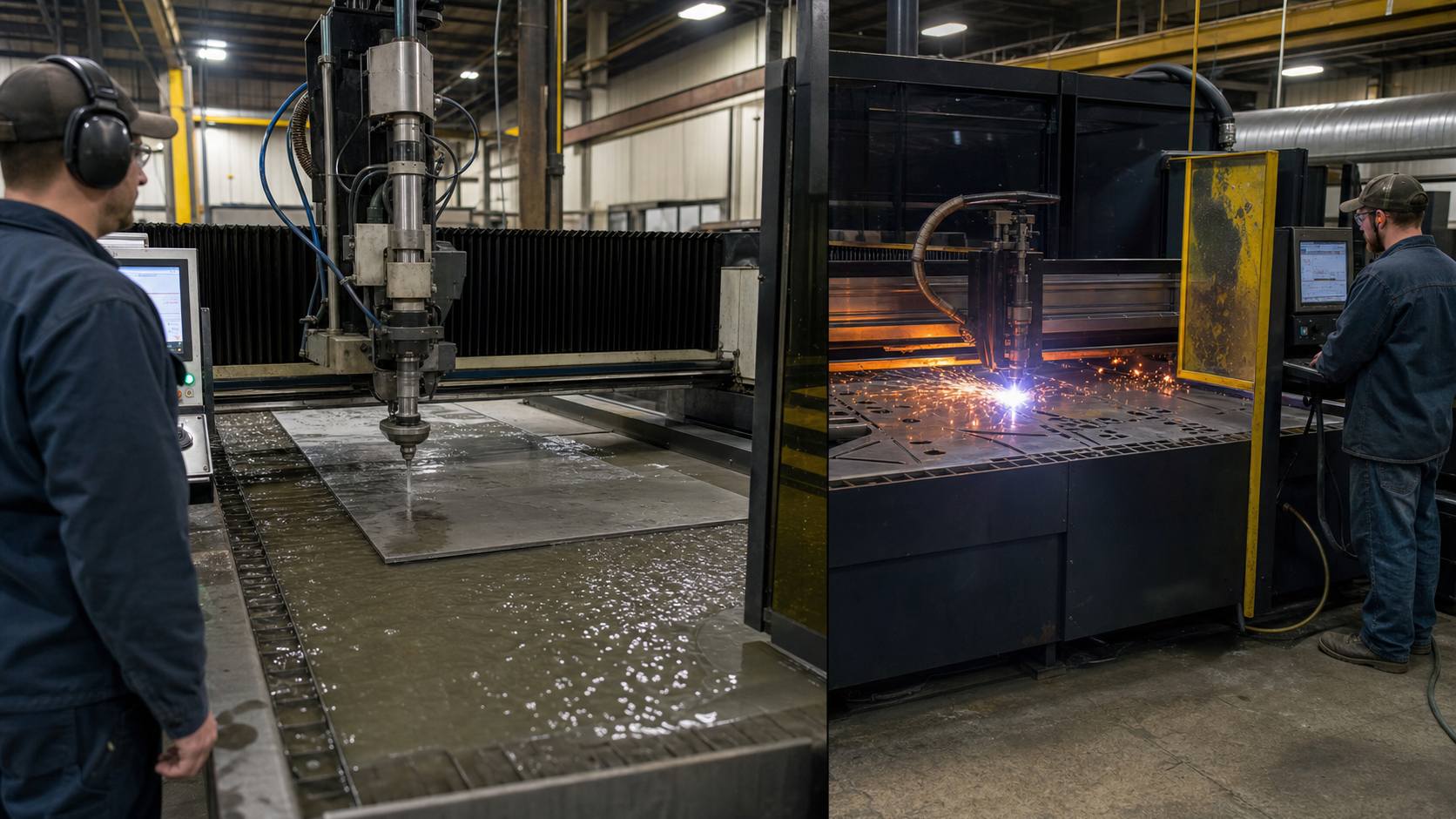
How Waterjet Cutting Works
Waterjet cutting pumps water at 50,000 to 90,000 PSI through a small orifice, then mixes it with abrasive garnet in a mixing chamber. The resulting high-velocity abrasive stream erodes material at the cut line without generating heat. The process is called a cold-cutting technology because the workpiece temperature stays near ambient throughout the cut.
The cutting head moves on a CNC gantry, following the part geometry from a CAD file. The kerf width is narrow, typically 0.030 to 0.050 inches depending on the orifice and abrasive mix. Because there’s no heat input, waterjet can cut through any material that the abrasive stream can erode: carbon steel, stainless steel, aluminum, brass, copper, titanium, stone, glass, rubber, and plastics.
Cut speed varies significantly by material and thickness. On 0.25-inch carbon steel, waterjet runs fast. On 2-inch stainless, it slows considerably. The abrasive consumption also adds direct cost, since garnet is consumed and disposed of with each cut. These factors mean waterjet cost-per-part is higher than plasma on most carbon steel jobs, but the edge quality and precision justify it for many applications.
Paragon’s waterjet cutting service handles structural plate, precision components, and parts that need to go directly to a secondary operation or assembly without additional edge cleanup. Parts up to 6 inches thick are within reach, though most production jobs run under 3 inches.
How Plasma Cutting Works
Plasma cutting passes an electrical arc through a pressurized gas stream, ionizing the gas into a plasma state that reaches temperatures above 20,000 degrees Fahrenheit. That superheated plasma melts through the metal, and the high-velocity gas flow blows the molten material out of the kerf. The process is fast, economical, and works on all electrically conductive metals.
Modern CNC plasma tables use high-definition plasma technology, which narrows the arc and produces significantly better edge quality than older conventional plasma systems. High-definition plasma closes the gap between plasma and laser on thinner material, though the heat-affected zone (HAZ) remains a fundamental characteristic of the process.
Plasma’s speed advantage over waterjet is most pronounced on carbon steel from 3/16 inch to 1.5 inches. On plate over 1 inch, plasma often outpaces laser as well. This makes it the default process for high-volume structural steel cutting where edge quality tolerances are moderate and per-part cost matters more than tight dimensional control.
The process is also significantly faster to set up than waterjet. No abrasive handling or high-pressure water system management is needed between jobs, which reduces changeover time and makes plasma well suited to mixed batches of structural pieces where cycle time drives economics.
For a three-way comparison that includes laser cutting, see our plasma cutting vs. laser cutting page and our laser cutting vs. waterjet comparison.
Edge Quality and Tolerances
Waterjet cut edges are smooth, square, and dimensionally consistent, with surface roughness typically in the Ra 125 to Ra 250 range depending on cut speed. Plasma edges have a slightly tapered bevel on the cut face (0.5 to 3 degrees) and a dross or slag line at the bottom of the cut that typically requires grinding for precision fits. Waterjet is the better choice when the cut edge is a mating surface or a visible cosmetic surface.
The tolerance comparison depends on machine quality and part complexity. A well-maintained CNC waterjet on flat plate holds plus or minus 0.005 to 0.010 inches without secondary finishing. A high-definition plasma system on the same plate holds plus or minus 0.015 to 0.030 inches, which is entirely acceptable for most structural parts, weldments, and frames that have welded joint gaps anyway.
Edge bevel is the more practical issue. Plasma cuts with a slight angle on the cut face because the arc fans slightly at the bottom of the kerf. This bevel is consistent and predictable but is present. For parts that need square cut edges, such as those being welded butt-joint with tight fit-up or parts being stacked and assembled with precise alignment, waterjet or laser cutting produces a better starting edge.
Dross (the hardened molten metal residue at the bottom of a plasma cut) is another consideration. High-definition plasma minimizes dross but doesn’t eliminate it on heavier plate. On thin gauge, it’s minimal. On 1-inch plate, light grinding or de-slagging is common. Waterjet leaves no dross because there’s no melting involved.
Materials and Thickness Range
Waterjet cuts any material, including non-metals, stainless, and titanium, in thicknesses from thin sheet to 6 inches or more. Plasma cuts conductive metals only, with the sweet spot on carbon steel from 3/16 inch to 2 inches. Stainless and aluminum can be plasma cut but with more edge quality variability than carbon steel. Non-metals cannot be plasma cut.
For shops that cut primarily carbon steel, the material question often doesn’t decide the process. Both waterjet and plasma work fine on A36, A572, and similar structural grades. The decision usually comes down to edge quality and quantity rather than material capability.
For mixed-material jobs, waterjet is frequently the only practical option. An assembly that requires steel brackets, aluminum spacers, and HDPE wear plates can all be cut on the same waterjet machine in the same setup. Plasma would require separate setups for each material (if it can cut them at all), and non-metals are simply off the menu.
For very thick structural plate, plasma remains cost-effective at thicknesses where laser cutting is not practical. Waterjet also handles thick plate, though cut speed drops and abrasive consumption climbs with increasing thickness. On 3-inch carbon steel, both processes are viable; the choice depends on edge quality requirements and volume.
Heat-Affected Zone (HAZ)
Waterjet cutting produces no heat-affected zone because it’s a cold process. Plasma cutting produces a narrow HAZ, typically 1/16 to 3/8 inch wide depending on plate thickness and cut speed. The HAZ is a zone of metallurgical change where the base metal’s grain structure and hardness are altered by the rapid heating and cooling cycle. For heat-treated or hardened materials, the HAZ is a significant concern.
The HAZ matters most in three situations. First, when the part material is heat-treated or case-hardened and the thermal cycle from cutting would alter the mechanical properties the treatment was intended to produce. Second, when the cut edge is close to a precision bore, bearing seat, or other dimensional feature that can’t tolerate hardness variation or distortion. Third, when the material is sensitive to thermal stress cracking, which is a concern in some high-carbon steels and certain alloys.
For standard structural carbon steel (A36, A572, hot-rolled plate), the HAZ from plasma cutting is not a practical concern for most fabricated parts. Weld prep, forming, or assembly operations that follow cutting are not sensitive to the narrow affected zone. Plasma is used routinely for structural steel without any special accommodations for the HAZ.
For stainless steel fabrications destined for food-grade or chemical service, the HAZ from plasma cutting can cause sensitization of the stainless, which reduces corrosion resistance in the heat-affected band. Waterjet eliminates this concern entirely and is the preferred process for stainless when corrosion performance at the cut edge matters.
Speed and Cost per Part
Plasma is faster than waterjet on most carbon steel thicknesses from 14 gauge to 2 inches. Waterjet cost-per-part is higher due to slower cut speed and abrasive consumption, but it’s often justified by eliminating secondary edge operations. For high-volume carbon steel structural parts where tolerances are moderate, plasma typically produces lower total part cost. For precision parts or mixed materials, waterjet’s superior edge quality reduces overall processing cost even at a higher cutting cost.
The economics change when you factor in secondary operations. A plasma-cut part that needs dross removal and edge grinding to achieve fit-up tolerances adds labor cost that can close the gap with waterjet. A waterjet part that goes straight to welding or assembly without cleanup saves that labor. The comparison is most useful when you look at total cost to a ready-to-assemble state, not just the cutting operation alone.
Setup time is also part of the cost picture. Plasma setups are fast and straightforward. Waterjet setups involve high-pressure system management and abrasive loading. On a high-mix, low-volume shop floor, plasma’s faster changeover time has real economic value.
For jobs where both processes are technically viable, your fabricator can quote both and give you the cost picture with and without secondary operations. That’s usually the clearest way to compare total cost for your specific part geometry and volume.
Process Comparison at a Glance
| Factor | Waterjet | Plasma |
|---|---|---|
| Heat input | None (cold process) | High (20,000+ °F arc) |
| Typical tolerance | +/- 0.005″ to 0.010″ | +/- 0.015″ to 0.030″ |
| Edge quality | Smooth, square, no dross | Slight bevel, dross on heavy plate |
| Heat-affected zone | None | 1/16″ to 3/8″ depending on thickness |
| Materials | Any: metals, stone, glass, composites | Conductive metals only |
| Carbon steel thickness | Up to 6″+ (slow above 3″) | Best 3/16″ to 2″ |
| Cut speed vs. plasma | Slower | Faster on most carbon steel |
| Cost per part | Higher (abrasive + speed) | Lower on structural carbon steel |
| Secondary edge work | Usually none needed | Dross removal common on thick plate |
| Best applications | Precision, stainless, mixed materials | High-volume structural carbon steel |
Which Process Should You Specify?
Specify waterjet when edge quality is a mating surface, the material is non-metal or HAZ-sensitive, or the part requires tight dimensional tolerances without secondary operations. Specify plasma when the material is carbon steel, thicknesses run from 3/16 to 2 inches, volume is high, and moderate tolerances with light edge cleanup are acceptable. When in doubt, describe the application to your fabricator and let the shop recommend the right process for the part.
The decision often breaks down by end use. Structural frames, machine bases, and weldments that allow for standard weld joint gaps usually go to plasma. Precision gussets, brackets with close-tolerance hole patterns, stainless parts for sanitary environments, and parts made from non-standard materials typically go to waterjet. Many shops, including Paragon, run both and can match the process to the part when you describe the application.
If you’re comparing processes for an OEM program with repeating parts, it’s worth asking your fabricator to cut a sample set on both processes and review the edge results before locking the process into the production routing. The cut quality difference is obvious in person and helps resolve debates that reference sheets can’t settle.
You can see both capabilities on our services overview and start a quote for your parts through our laser cutting page, which includes routing to waterjet or plasma based on part requirements.
Get a Cut Process Recommendation
Send us your part drawings and material specs. Our team will recommend waterjet or plasma based on your tolerances, material, and volume and quote accordingly.
Frequently Asked Questions
Can plasma cut stainless steel?
Yes, plasma can cut stainless steel, but edge quality is less consistent than on carbon steel and the heat-affected zone can cause sensitization that reduces corrosion resistance in the cut zone. For stainless parts going into food processing, chemical, or pharmaceutical environments, waterjet or laser cutting is typically the better choice because neither introduces significant heat into the material.
What is the typical kerf width for each process?
Waterjet kerf width is typically 0.030 to 0.050 inches depending on the orifice size and abrasive mix. Plasma kerf on a high-definition system runs 0.060 to 0.090 inches on thin plate and wider on heavy plate. Kerf width matters for nesting efficiency on sheet and for maintaining minimum web widths between holes and edges. Your fabricator’s CAM software accounts for kerf when programming parts.
Does waterjet leave a rough edge?
At standard cut speed, waterjet edges have a surface roughness in the Ra 125 to Ra 250 range, which is smooth to the touch but shows visible toolpath marks under close inspection. At slower “quality” cut speeds, edges come in smoother, closer to Ra 63. For most fabrication applications, the standard waterjet edge is acceptable without secondary finishing. For visible cosmetic surfaces or precision mating surfaces, ask for a quality-mode cut.
Which process is better for very thick plate?
Both waterjet and plasma cut thick plate (1 inch and above), but plasma is faster on carbon steel in the 1 to 2 inch range. Above 2 inches, plasma struggles with consistent quality and waterjet becomes the better option for flat-plate cutting, though it’s slower. Oxy-fuel cutting is also used on very thick structural plate and remains a common choice for thicknesses above 2 inches where high cut speed matters. Contact our team with your plate thickness and we’ll recommend the right process.
or call 1-800-467-0121