
Quoting and Planning / Production Strategy
One-Off Prototype vs. Production Run in Metal Fabrication: What Changes?
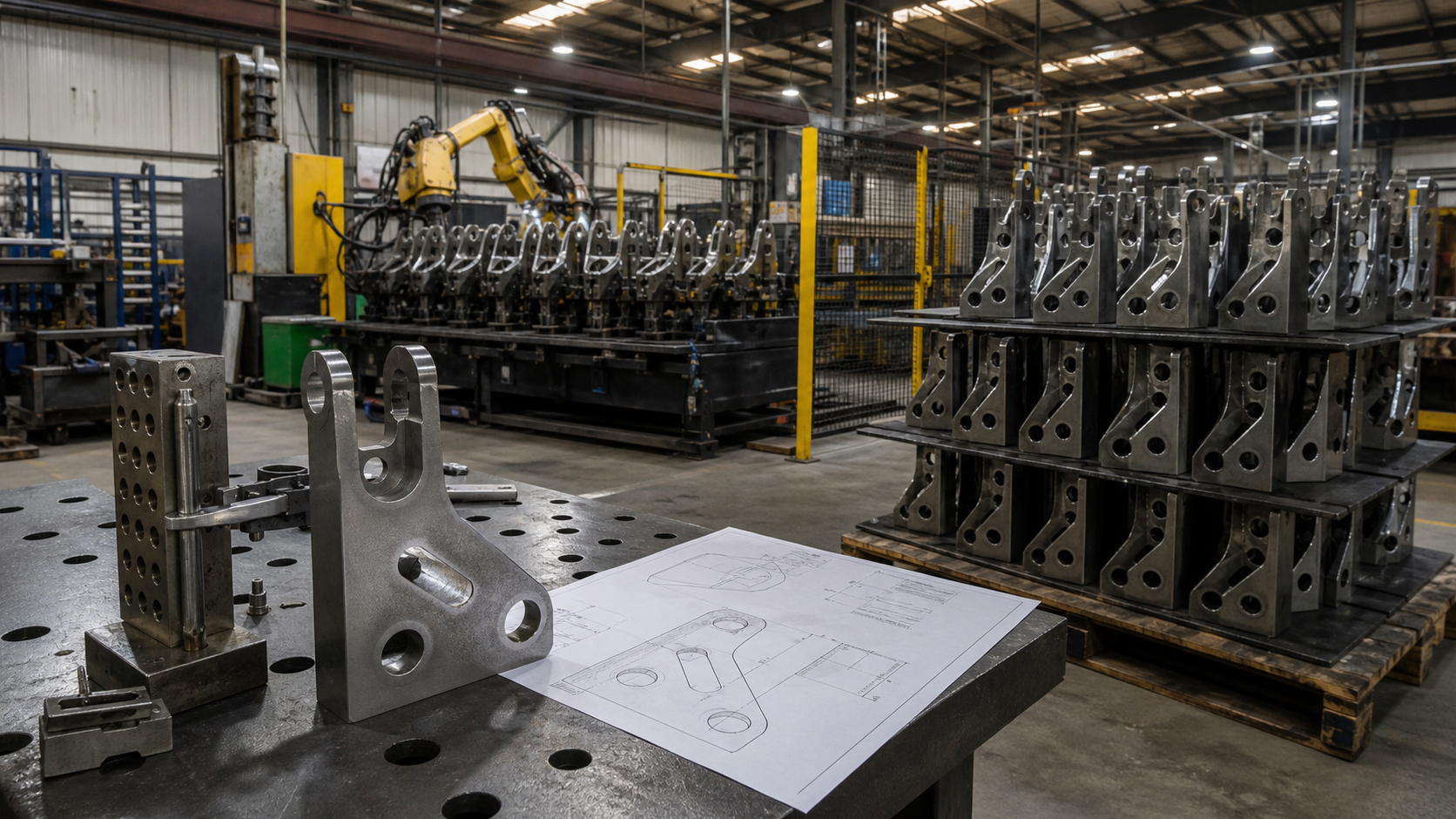
A prototype run and a production run differ most in how setup costs are spread, how material is sourced, and what level of inspection applies. On a single prototype, every setup cost falls on one part, so unit cost is high. On a production run of 50 to 100 or more pieces, setup is amortized across the lot and unit cost drops significantly. Processes, tolerances, and fixturing strategy may also shift between prototype and production as the design is finalized.
Setup Costs and Amortization
Setup cost is the primary driver of the cost difference between a prototype and a production run. Every job requires programming, fixturing, and first-article inspection regardless of quantity. On one part, those fixed costs are carried entirely by that one part. On 100 parts, the same fixed cost spreads across the lot and becomes a small fraction of each unit’s total cost.
On a CNC laser cut job, programming takes the same amount of time whether the shop is cutting one part or 500. The nesting programmer loads the DXF, sets the cut parameters, and approves the program. That labor and machine time is a setup cost that doesn’t scale with quantity. Add fixturing for a formed or welded part and the fixed cost goes up further.
This is why prototype quotes can look alarming compared to production cost estimates. A buyer who sees a prototype at $340 per piece and a 100-piece production run at $62 per piece hasn’t found a pricing inconsistency. They’ve seen setup amortization at work. The setup cost is roughly the same in both scenarios; what changes is how many parts carry it.
From a planning standpoint, it’s useful to ask your fabricator for a quantity-break price structure at the quoting stage. Getting the per-piece cost at 1, 10, 25, 50, and 100 units at the same time gives you a roadmap for how costs will fall as you move from development into production. Most shops are happy to provide this with the initial quote if you ask.
For a broader look at the cost variables in metal fabrication, see our page on what drives custom metal fabrication pricing.
Material: Stocked vs. Special Order
Prototype material is often a partial sheet or a remnant from stock, which keeps material cost from ballooning on a single-piece order. Production runs typically buy full sheets or coils, which lowers material cost per pound and improves yield through optimized nesting. If the prototype requires a non-stock alloy, grade, or thickness, expect a material surcharge and longer lead time compared to a production order.
Material availability affects both cost and lead time differently for prototypes and production. For a prototype, the fabricator can usually cut a small piece from an existing stock sheet without waiting for a mill order. The material cost on that small piece may carry a premium because the shop loses yield on the parent sheet, but the lead time is fast.
For production quantities, material is typically ordered to the job. The fabricator reviews the nesting, calculates the number of sheets or the linear footage of tube needed, and places a material order. Standard grades (A36, A572, 304 stainless, 6061 aluminum, common wall tubing) ship within a few days from service center stock. Non-standard grades, thicknesses, or certifications add lead time and minimum order quantities.
Locking material grade and thickness at the prototype stage is good practice if you expect to move to production. Changing from one spec to another between prototype and production (for example, switching from 11-gauge to 3/16-inch plate because of a design change) means a new setup, new nesting, and potentially new programming, which adds cost that can offset quantity savings.
Tolerances and Inspection
Prototype inspection is often 100 percent of features on every part, because the goal is to validate the design. Production inspection typically shifts to a sampling plan, first-article approval, and in-process checks, since the process has been validated and the goal changes from design discovery to process control. This shift reduces inspection labor cost per piece in production without sacrificing overall quality control.
On a prototype, the shop measures everything it can reach: critical hole locations, formed angles, overall dimensions, and any feature called out on the print. The purpose is to generate data that tells the engineer whether the design is producing the intended geometry. Dimensional reports and red-lined prints are common deliverables on prototype runs.
On a production run, first-article inspection (FAI) validates the first piece or pieces from the production setup before the full lot runs. After FAI approval, in-process inspection uses spot checks and SPC data to confirm the process stays in control. Final inspection on a production run usually follows a statistical sampling plan rather than 100 percent inspection of every piece.
If your part has critical dimensions that carry safety or functional implications, make sure those are clearly identified on the print and in your RFQ. See our metal fabrication RFQ checklist for what to include to ensure inspection requirements are understood before the job starts.
Tolerance changes between prototype and production are worth flagging explicitly. If the prototype print carries general tolerances and the production print tightens up specific critical dimensions, that’s a new quoting event, not an assumed continuation of the prototype price.
Tooling and Fixturing
Prototype runs typically use general-purpose fixturing or tack-and-fit setups rather than dedicated production fixtures. Production fixturing is built for repeatability and speed, holding parts in consistent position for welding or assembly without operator-to-operator variation. Dedicated fixtures are an upfront investment that pays back quickly on medium and high volumes through faster cycle times and more consistent output.
A welded assembly prototype may be built on a flat plate with clamps and angle stops, which is fast to set up and flexible for design changes. That approach works well for one or five pieces. On a production run of 50 units, building each one to clamp-and-fixture takes the same amount of operator time per piece, and variation in tack-up position shows up as dimensional scatter across the lot.
Production fixtures for weldments hold all components at precise angles and locations so the operator can tack without measuring each joint. A good fixture also constrains the assembly against weld distortion, which reduces straightening time after welding. The fixture build cost is typically one-time and can be amortized over the production run or held for future orders.
Ask your fabricator whether a production fixture makes sense for your parts when the prototype run is complete. For parts with multiple welds, tight dimensional requirements after welding, or high repeat volume, the fixture investment usually returns within the first production lot through reduced cycle time and scrap.
How Your Quote Changes with Volume
Per-piece price decreases as quantity increases, but not linearly. The biggest drop typically happens in the jump from 1 to 10 pieces, where setup cost goes from 100 percent of one unit’s cost to roughly 10 percent. Additional savings from 10 to 100 pieces come from material nesting efficiency, reduced setup frequency, and fixture amortization. Above 100 pieces, savings continue but at a slower rate as the fixed cost component is already spread thin.
The practical implication for buyers is that moving from 5 pieces to 10 pieces often saves more money per unit than moving from 50 pieces to 100. If you’re in early production and have flexibility in order quantity, pushing the initial production run from 5 to 10 or from 10 to 25 units can improve per-piece economics substantially without committing to inventory that ties up cash.
Blanket orders and scheduled releases are another tool for production planning. A blanket order commits to a total quantity (say, 200 pieces over the year) in exchange for production pricing, with individual release orders pulling parts as needed. This gives the fabricator a planning horizon to order material and schedule capacity while the buyer gets production pricing without taking 200 pieces at once.
Lead time also shifts with quantity. A single prototype can often be turned in days. A 50-piece production run requires material procurement, scheduling into the production queue, and possibly fixture build time. See our metal fabrication lead times page for a realistic picture of how lead time scales with complexity and quantity.
Planning the Transition from Proto to Production
The smoothest transition from prototype to production happens when design changes are captured in a revised print before the production quote, material and tolerances are locked, inspection requirements are documented, and the fabricator knows the production volume and cadence before quoting. Prototype-to-production surprises almost always trace back to assumptions that weren’t spelled out at the prototype stage.
Document every change between the prototype and production drawing. If the prototype revealed a fit issue that required a dimension change, or if an engineer updated wall thickness based on stress analysis, those changes need to be on the production print. Quoting from a prototype print when a red-lined revision exists is a recipe for a shop building parts that don’t match the current design intent.
Communicate the anticipated production volume and cadence to your fabricator at or shortly after prototype review. A shop that knows you’ll be ordering 25 pieces per quarter can plan material, fixturing, and capacity accordingly. That communication also gives the shop confidence to invest in production fixturing, since they know there’s repeat business behind it.
Be explicit about what the prototype is validating. If the prototype is purely a fit check and function testing hasn’t started yet, say so. If the prototype is intended to be the first of the production parts (a first article), that carries different expectations about quality documentation and sign-off. Both approaches are valid, but they require different handling and the fabricator needs to know which they’re building to.
Ready to transition your prototype to production? Our team can review your parts, update the quote for production quantities, and recommend fixturing where it makes sense. See our full services overview or contact us to start the conversation.
From Prototype to Production
Paragon handles both. Tell us where you are in the process and we’ll quote the right run size with a roadmap for scaling to production pricing.
Frequently Asked Questions
Is the prototype quote a good predictor of production cost?
No, not by itself. A prototype quote carries the full setup cost on one or a few parts, which inflates per-piece price significantly compared to production. To get a useful cost predictor for production, ask your fabricator for quantity-break pricing at the same time as the prototype quote: 1 piece, 10 pieces, 50 pieces, and 100 pieces. That structure shows you how costs fall with volume and gives you a realistic production cost target before you’ve locked the design.
Should I order a small prototype run or go straight to production?
If the design is unproven or the part will interface with other new components, build a prototype first. The cost of reworking or scrapping a production lot of 50 pieces with a design error far exceeds the cost of a 1 to 5 piece prototype run to validate fit and function. If the design is already proven on a previous similar part or the tolerances are generous, you can sometimes go straight to a small initial production run. Your fabricator can advise based on part complexity and how well-defined the print is.
How do lead times differ between prototype and production?
Prototype lead times are often faster because the shop can cut a single piece from stock material without waiting for a material order, and the part can slot into gaps in the production schedule. Production runs require material procurement, scheduling into a production window, and potentially fixture build time. A reasonable expectation for a production run is 2 to 4 weeks from approved print to delivery for standard complexity parts, though complexity, material spec, and current shop loading all affect the actual number.
Do I need a new quote when I scale up from prototype to production?
Yes, always get a new quote for production. The prototype quote covers the prototype quantity at prototype pricing and should not be used to estimate production cost. If the print has changed since the prototype, a new quote is essential because even minor drawing changes can affect material nesting, programming, or process routing. Provide the current revision of the print and the target production quantity, and ask the shop to quote with and without production fixturing so you can see the fixture ROI.
or call 1-800-467-0121