Buyer’s Guide / Metal Fabrication Services
How to Choose a Metal Fabrication Shop
To choose a metal fabrication shop, evaluate years of experience with work similar to yours, whether the shop runs in-house capabilities like cutting, forming, welding, and finishing under one roof, how they handle quality and certifications, and whether their capacity matches your production volume. Get multiple quotes, but don’t pick on price alone. The right partner treats your parts like their own.
What to Look For in a Fabrication Shop
The right metal fabrication shop has demonstrable experience with your type of work, capabilities that match your requirements, a quality system that catches problems before parts ship, and enough capacity to hit your timeline consistently. The wrong shop can cost you far more in rework, delays, and coordination overhead than the savings from a lower quote number.
Choosing a fabrication partner is not like buying a commodity. Two shops can quote the same print and deliver parts that are worlds apart in quality, fit, and reliability. The price difference between them might be 8%. The cost difference when one of them fails on a production run could be measured in days of downtime and lost customer orders.
This guide walks through the specific criteria that separate a capable, reliable shop from one that looks good on paper. Use it before you send your first RFQ, and revisit it when you’re comparing quotes. See our full fabrication services page for the capabilities we bring to every job.
Experience and Past Work
Look for a shop with documented experience on parts similar to yours in material, complexity, and volume. Years in business matters less than relevant experience. A shop that’s been cutting 16-gauge enclosures for 20 years might not be the right fit for heavy structural weldments, and vice versa. Ask to see examples or references from similar work before you commit.
The most useful question to ask a potential fabricator is: “Can you show me examples of parts like mine that you’ve made?” A shop confident in their work will answer that without hesitation. If the response is vague, that tells you something.
Years in operation is a reasonable proxy for stability, but it’s not the whole story. A 40-year-old shop that has invested in equipment and process consistently over those four decades is a different animal from one that coasted on legacy equipment and relationships. Look for evidence of ongoing investment: newer CNC equipment, expanded facilities, a growing capability set.
Ask about their customer base by industry. If you’re in automotive manufacturing, a shop that serves aerospace customers isn’t automatically a good fit; they may have quality systems built for aerospace tolerances that add cost and lead time you don’t need. Conversely, if your parts are high-tolerance, a shop that primarily serves agricultural OEMs may not have the process control you require.
In-House Capabilities Under One Roof
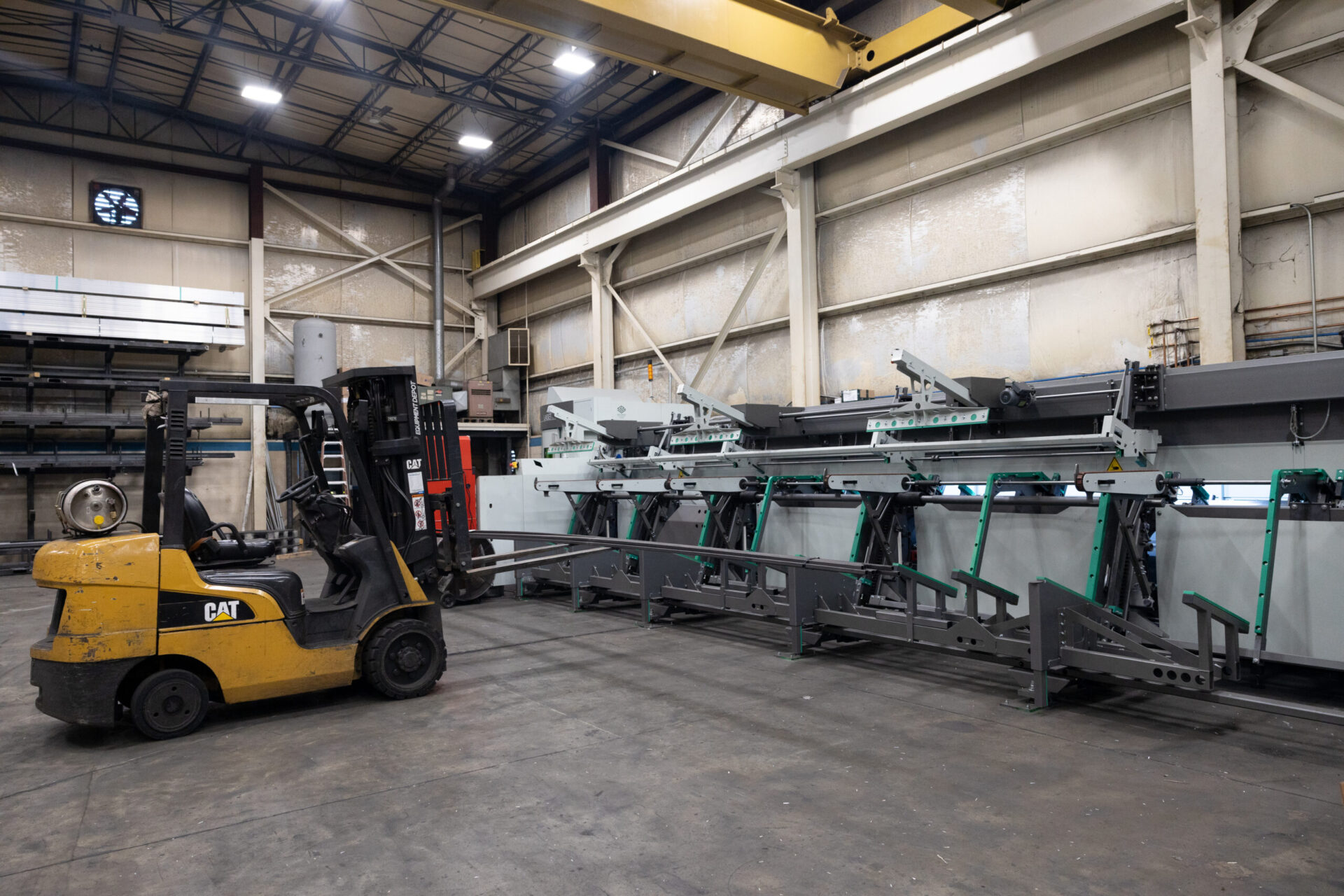
A shop with cutting, forming, welding, and finishing under one roof lowers your landed cost and simplifies your supply chain. When operations happen in sequence at one facility, there’s no freight cost between vendors, no scheduling risk, and quality can be verified at each step. Every vendor handoff in a multi-shop supply chain is a risk point for damage, delay, and communication error.
Consider a typical fabricated assembly: laser cut blanks, press brake formed to shape, welded into a weldment, powder coated for protection. If those four steps happen at four different shops, you’re coordinating four schedules, four quality standards, and four freight legs. Any one of them can slip and cascade into a late delivery to your customer.
When all four steps happen at one shop, the scheduling is internal. The quality review at step two catches drawing interpretation issues before they become welding problems. The powder coat line knows exactly what substrate they’re receiving and can flag a surface defect before it’s painted over. This is what “lower landed cost” actually means in practice, not just a lower per-piece price, but fewer coordination hours, fewer surprises, and a shorter total cycle time from raw material to finished part.
It also affects design-for-manufacturability (DFM). A single-source shop can review your drawing holistically and catch a bend radius that will cause forming problems before the laser runs the first blank. A shop that only does laser cutting will quote the cut and let someone else figure out the forming issue.
Our facilities page covers the equipment and floor space behind Paragon’s single-roof capability, from laser and waterjet cutting through forming, welding, rolling, CNC machining, and powder coating.
Quality Systems and Certifications
Ask about the shop’s quality process: how they verify incoming material, how they check dimensions during production, and how they document nonconformances. Certifications like ISO 9001 signal a documented quality management system. AWS-certified welders indicate a measurable welding standard. Ask what certifications they hold and, more importantly, how their quality system works day to day.
Certifications matter, but process matters more. A shop with a quality certification and a culture of skipping inspection steps is more dangerous than a shop without formal certification that genuinely checks every operation. The certification is evidence that someone documented the right processes; the culture determines whether those processes actually run.
Ask direct questions. “What happens when a part fails first-article inspection?” A good shop has a clear nonconformance process, a root-cause investigation protocol, and a corrective action that prevents recurrence. A shop that says “we fix it and move on” has a different quality culture.
For welded assemblies, welder qualification is particularly important. AWS D1.1 for structural steel and AWS D1.6 for stainless steel are the standard qualification tests. If your parts will carry load or go into a safety-critical application, ask whether the shop’s welders carry current qualifications for those codes.
Material traceability is another checkpoint. Can the shop provide mill certifications for the raw material in your parts? For regulated industries or quality-critical applications, that traceability may be a contractual requirement. Know this before you award the job.
Capacity Matched to Your Volume
A shop that’s a great fit for prototype quantities may not have the machine capacity to run your production volume without pushing your order to the back of a crowded schedule. Conversely, a high-volume production shop may not have the flexibility or patience for a 10-piece prototype run. Match the shop’s typical order profile to yours before you build a dependency on them.
Volume mismatch is one of the most common reasons a fabrication relationship fails after the first successful order. You run a prototype with a small shop, they do great work, you award them the production contract for 500 pieces a month, and suddenly your parts are three weeks late every cycle because a larger customer bumped you.
Ask about the shop’s typical order sizes and customer base. If your annual spend would represent 30% of their revenue, that’s not necessarily bad, but you should understand the dynamic. If it would be 2%, understand that you may not have the priority you expect during a crunch.
Equipment redundancy matters too. A shop with a single laser and no backup has a single point of failure. If that machine goes down for a rebuild, your parts stop. A shop with multiple machines in a process family can route work around a down machine and protect your delivery commitment.
Getting and Comparing Quotes
Get quotes from at least two or three shops. Compare total cost of ownership, not just the per-piece price: factor in freight, lead time, rework history, and how often each shop hits their delivery commitments. A quote that’s 10% lower from a shop with a 40% on-time delivery rate is not a better deal. The right partner costs less over a year than a cheap one that misses every other shipment.
When you receive quotes, make sure you’re comparing equivalent specs. “Laser cut and formed” means different things at different shops depending on tolerance standards, material grade assumptions, and what operations are included. If one quote is dramatically lower than the others, find out why before assuming it’s a win.
Ask each shop: “What is your current lead time for a first-run job like this?” and “What is your on-time delivery rate?” A shop that can’t answer the second question confidently hasn’t been measuring it. Both answers should factor into your decision as heavily as price.
Reference checks are underused in fabrication sourcing. Ask for two or three customer references with similar part types, call them, and ask two questions: Did parts arrive on time? Were there quality issues, and how did the shop handle them? The answers will tell you more than any sales conversation.
For a complete guide to what to include in your RFQ to get accurate, comparable quotes, see what to include in a metal fabrication RFQ. And if you’re thinking about what to expect on timeline, custom metal fabrication lead times walks through prototype vs. production cycle times.
Why Choose Paragon Metal Fabricators
Paragon Metal Fabricators brings 40+ years of family-owned fabrication experience to the tri-state region (Northern Kentucky and Greater Cincinnati). We run laser cutting, tube laser, waterjet, press brake forming, rolling, CNC machining, welding, and powder coating under one roof, from single prototypes to high-volume production runs, with a team that treats your parts as if our name were on the finished product.
We started with the basics and built capability deliberately over four decades. Today our Hebron, KY shop handles the full fabrication cycle without hand-offs to outside vendors for the core operations. That means your drawing review, DFM feedback, material procurement, cutting, forming, welding, and powder coat all happen in one coordinated workflow with one point of contact.
The industries we serve span agriculture, automotive, air handling, consumer products, energy, material handling, mining, construction, and packaging equipment. That range means your parts aren’t something we’re figuring out for the first time; they fit into a process profile we’ve run before.
We’re a family-owned business, which means the people making decisions about your job are the same people whose names are on the building. There’s no layer of middle management between your project and accountability. When you call with a question or an issue, you talk to someone who can actually do something about it.
Start with a Free Quote
Send us your drawing and tell us what you’re making. We’ll review it, flag any DFM issues, and come back with a quote. No obligation. 40+ years of experience. One roof. Tri-state delivery.
Frequently Asked Questions
What certifications should a metal fabrication shop have?
The most relevant certifications depend on your application. ISO 9001 indicates a documented quality management system. AWS D1.1 (structural steel) and AWS D1.6 (stainless steel) are the standard welder qualification codes. For aerospace or defense work, NADCAP or AS9100 may be required. Ask any candidate shop what certifications they hold, and verify they’re current before awarding sensitive work.
Should I pick the lowest quote from a fabrication shop?
No. The lowest quote rarely reflects the lowest total cost of ownership. Factor in on-time delivery rate, quality history, freight costs if the shop is remote, and the overhead of managing quality issues. A shop that’s 10% cheaper but hits its delivery commitments 60% of the time will cost your operation far more than a slightly higher-priced shop that ships on time and right the first time.
Why does in-house finishing matter when choosing a fabrication shop?
When a shop runs finishing (powder coating, painting, or other surface treatment) in-house alongside cutting, forming, and welding, it removes freight legs, scheduling risk, and quality handoff points from your supply chain. It also means the shop inspects parts at each step before committing to the next operation, which catches problems earlier and cheaper. In-house finishing consistently delivers lower landed cost and shorter cycle time compared to multi-vendor supply chains.
or call 1-800-467-0121